

If you are interested in the product and want more information, please leave your information .

WeChat (China) : +86 15075780050
Email : sam@greatforming.com
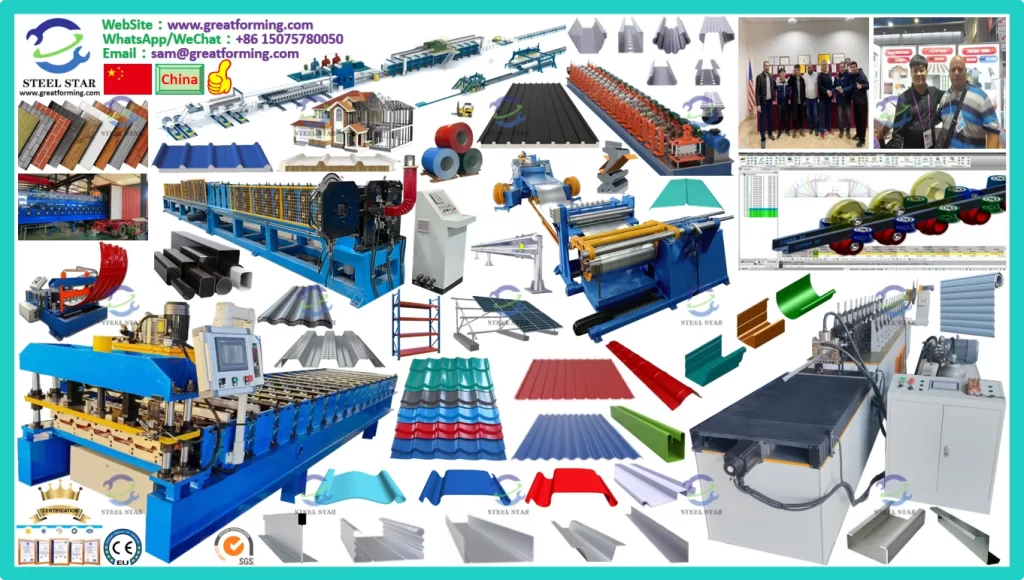
Below is a brochure of our factory products, which can be viewed and downloaded.
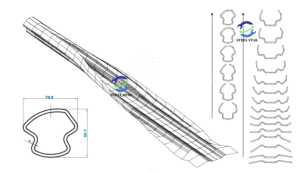
Roll forming is a type of rolling that involves continuously bending long strips of metal sheet (typically coiled steel) into the desired cross-section. Design the mold shape and number of groups according to the required size. The shrinkage ratio of each group of cold bending is different. Through cold bending group by group, the final desired size can be achieved. Combined with electronic control system, hydraulic system, shearing system and counting encoder to realize automated operation. 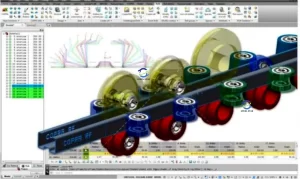
Technical Parameters :
- Raw material width : 914mm / 925mm / 1000mm / 1200mm / 1220mm / 1250mm (Can be customized according to your needs)
- Thickness of sheet : 0.15mm — 1.0mm (Can be customized according to your needs)
- speed : 15 m — 5 0 m/min (Can be customized according to your needs)
- Voltage : 380v 50hz 3phase / 220v 60hz 3phase (Can be customized according to your needs)
- Language : English / Spanish / Arabic / Russian / Portuguese / German / French (Can be customized according to your needs)
- Material of rollers : C45 / Gcr15 / Cr12 / Cr12 Mov (Can be customized according to your needs)
- Motor brand : Siemens / other (Can be customized according to your needs)
- Electronic control PLC : Siemens / Delta (Can be customized according to your needs)
- Number of roller rows: According to product design
Application Scenarios :
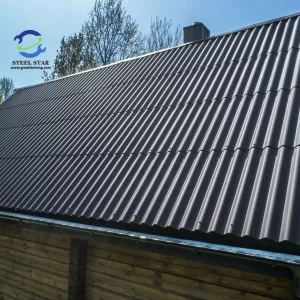
Equipment Production Line:
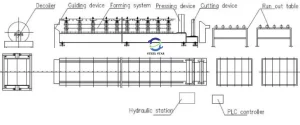
Related Product Layout Diagrams:
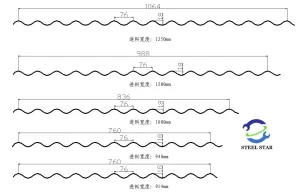
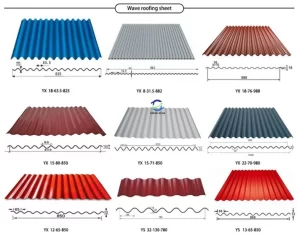
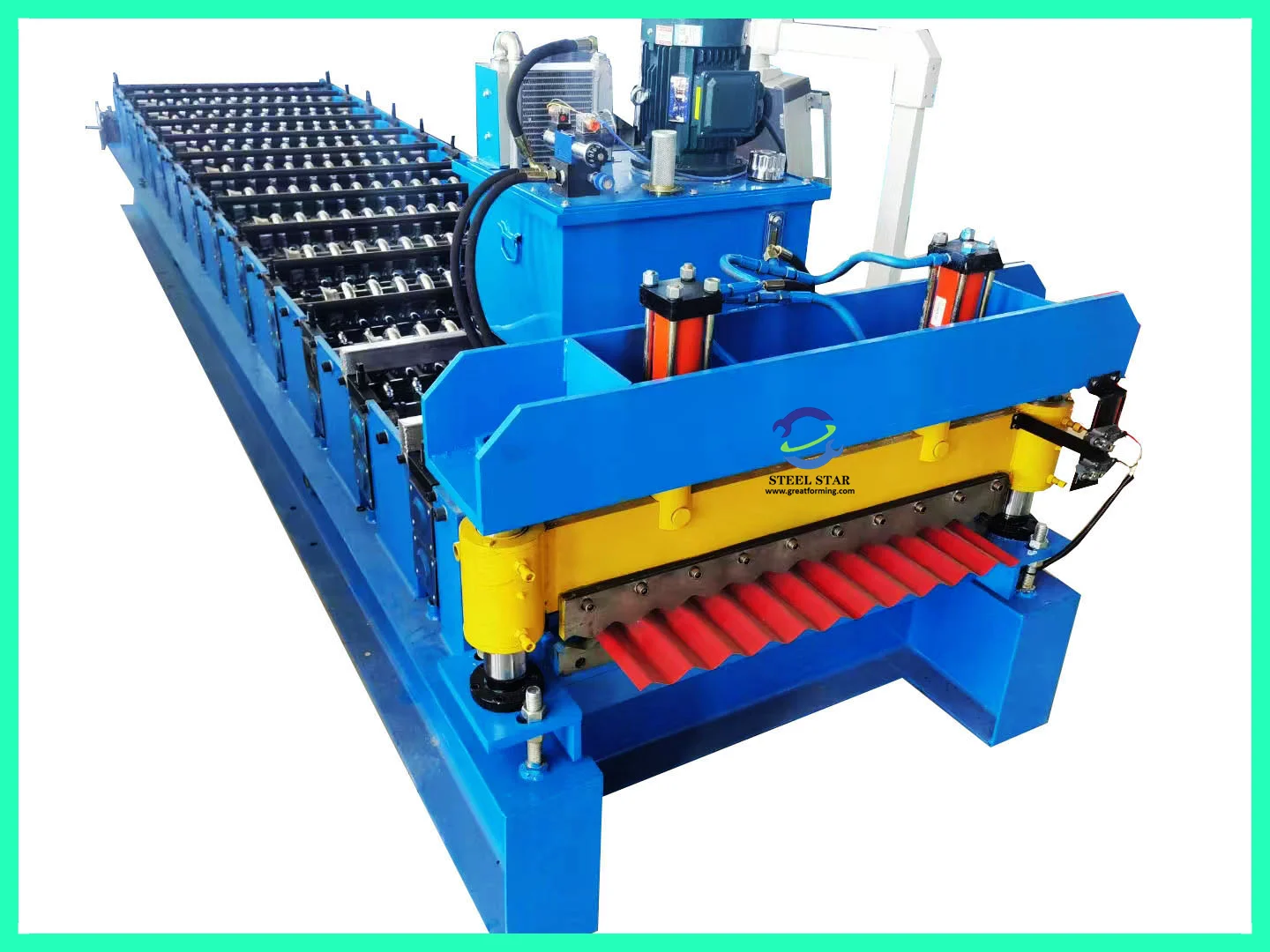
The Corrugated Roof Sheet Roll Forming Machine: The Backbone of Modern Metal Roofing
In the world of modern construction, efficiency, durability, and cost-effectiveness are paramount. At the heart of the metal roofing industry lies a piece of equipment that embodies these principles: the **Corrugated Roof Sheet Roll Forming Machine**. This specialized industrial machinery is responsible for transforming flat metal coils into the iconic, wave-like corrugated panels that protect homes, factories, and agricultural buildings worldwide.
What is a Corrugated Roof Sheet Roll Forming Machine?
A roll forming machine is a continuous bending operation system used to shape sheet metal into long, uniform profiles. Unlike press braking, which creates bends one at a time, roll forming uses a series of consecutive stands (or stations) of rollers that gradually shape the metal as it passes through.
The **corrugated roof sheet** is the most classic product of this process. Characterized by its sinusoidal (wave-like) profile, this design has been used for over a century because it provides exceptional structural strength to thin-gauge metal, allowing it to span large distances without sagging.
Key Components of the Machine
A standard corrugated roll forming machine consists of several critical components working in harmony:
1. Decoiler: The process begins with the decoiler, which holds the heavy coil of raw material (typically galvanized steel, aluminum, or pre-painted steel). It feeds the strip into the machine at a controlled speed, ensuring constant tension.
2. Feeding and Guiding System: Before entering the rollers, the metal passes through a series of guides and levelers to ensure it is perfectly aligned and flat. Misalignment at this stage can lead to twisted final products.
3. Roll Forming Stations: This is the core of the machine. Depending on the thickness of the metal and the complexity of the profile, the machine may have between 12 and 20 stations. Each set of rollers performs a small, incremental bend. By the time the metal exits the final station, the full corrugated profile has been achieved without causing stress fractures in the material.
4. Hydraulic Cutting System: After the sheet reaches the preset length (programmed via a PLC controller), a hydraulic shear cuts the panel to size. High-quality machines utilize a “flying shear” system, which moves with the metal to allow cutting without stopping the production flow.
5. PLC Control System: Modern machines are controlled by a Programmable Logic Controller (PLC). This allows operators to input the desired length, quantity, and speed. The automation reduces human error and allows for high-speed, high-volume production with minimal labor.
The Advantages of Roll Forming for Corrugated Sheets
The popularity of this specific machine stems from the distinct advantages it offers over traditional manufacturing methods:
High Efficiency: These machines can produce thousands of meters of roofing sheets per shift. Production speeds typically range from 10 to 30 meters per minute, ensuring that large-scale construction projects never face material delays.
Material Optimization: Because the process is a cold-forming technique (no heat required), there is no warping or material loss due to melting or burning. The precision of the system also minimizes waste at the ends of coils.
Consistency and Precision: When constructing a roof, even a millimeter of variance can cause leaks or fitting issues. Roll forming ensures that every single sheet is an exact replica of the one before it, guaranteeing a watertight seal when overlapped.
Portability: While large industrial machines exist for factories, many manufacturers produce **mobile roll forming machines**. These are trailer-mounted units that can be taken directly to the construction site. This eliminates the need for long-haul transportation of bulky, fragile roofing sheets, significantly reducing shipping costs and damage risks.
Applications
Corrugated metal sheets produced by these machines are ubiquitous across various sectors:
Residential: Roofing for sheds, garages, and modern homes seeking a rustic or industrial aesthetic.
Agriculture: Barns, silos, and animal shelters rely on corrugated metal for its resistance to moisture, pests, and fire.
Commercial: Warehouses and factories utilize corrugated cladding for walls and roofs due to its longevity and low maintenance.
Infrastructure: Bus stops, canopies, and temporary structures.
Choosing the Right Machine
When investing in a corrugated roof sheet roll forming machine, manufacturers typically consider three main factors:
1. **Material Width and Thickness:** Machines must be spec’d to handle the specific gauge (thickness) of steel or aluminum required for the market. Heavy-gauge steel requires stronger roller stands (often cast iron) and higher horsepower motors.
2. **Profile Shape:** While “corrugated” is standard, the pitch (distance between peaks) and height of the waves vary by region (e.g., 9-wave vs. 18-wave profiles).
3. **Automation Level:** Entry-level machines require manual cutting, while fully automated lines include stackers that automatically count and bundle the finished sheets for packaging.
The **Corrugated Roof Sheet Roll Forming Machine** is more than just a fabrication tool; it is a critical enabler of the global construction supply chain. By combining the ancient principle of the arch (the corrugated wave) with modern automation and metallurgy, it provides a solution that is fast, sustainable, and structurally sound.
As the demand for metal roofing continues to grow—driven by its durability, recyclability, and resistance to extreme weather—the roll forming machine remains an indispensable asset for contractors, manufacturers, and builders looking to bridge the gap between raw materials and finished structures.
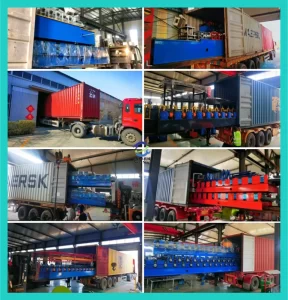
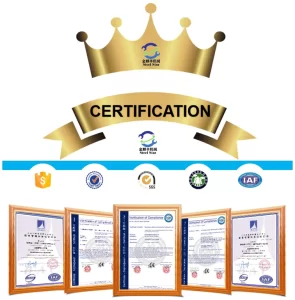
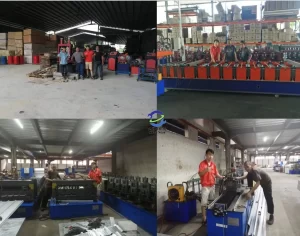
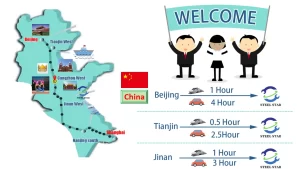
Factory Information:


Website:
www.greatforming.com (English)
www.arabicgreatforming.com (عربي)
www.russiangreatforming.com(Русский)
www.spanishgreatforming.com(Español)
www.frenchgreatforming.com(Français)
www.portuguesegreatforming.com(Portuguese)