

If you are interested in the product and want more information, please leave your information .

WeChat (China) : +86 15075780050
Email : sam@greatforming.com
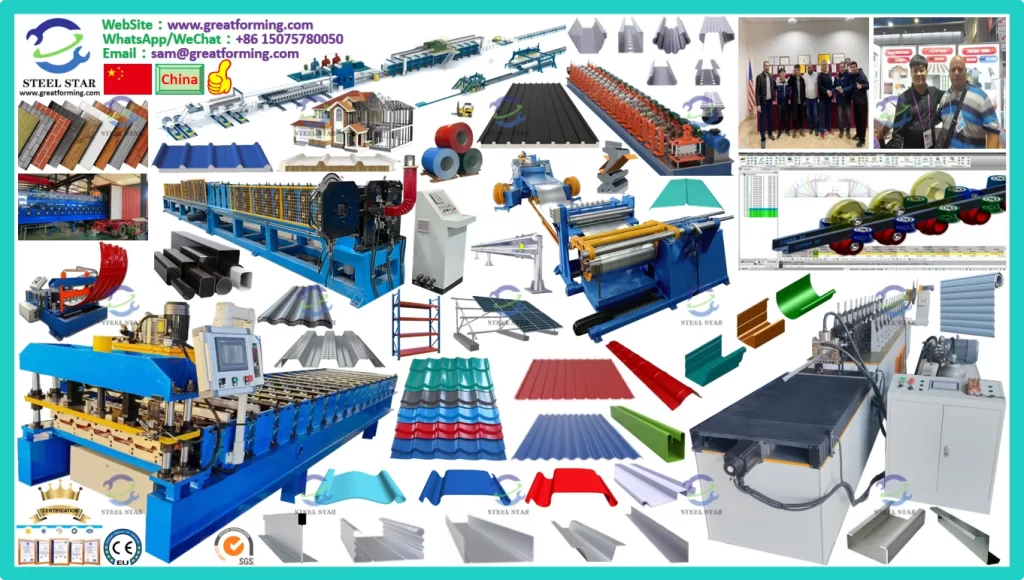
Below is a brochure of our factory products, which can be viewed and downloaded.
Roll forming is a type of rolling that involves continuously bending long strips of metal sheet (typically coiled steel) into the desired cross-section.
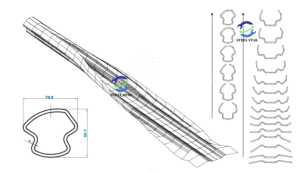
Design the mold shape and number of groups according to the required size. The shrinkage ratio of each group of cold bending is different. Through cold bending group by group, the final desired size can be achieved. Combined with electronic control system, hydraulic system, shearing system and counting encoder to realize automated operation.
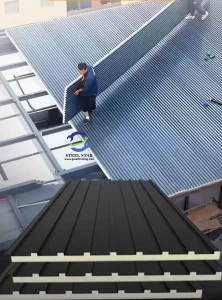
Application Scenarios :
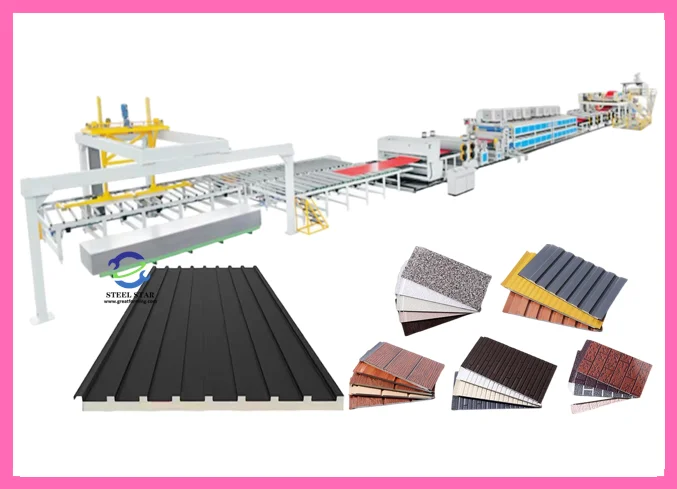
Equipment Production Line:
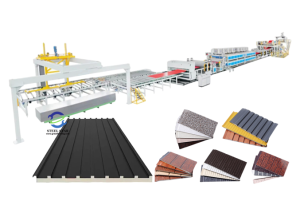
The Technology Behind PU Sandwich Panel Machines: Manufacturing High-Performance Insulation
In the realm of modern construction and industrial insulation, the polyurethane (PU) sandwich panel has emerged as a material of paramount importance. From the walls of cold storage facilities to the cladding of energy-efficient buildings, these composite elements provide exceptional thermal insulation, structural rigidity, and design flexibility. At the heart of their production lies a sophisticated piece of engineering: the **Polyurethane Sandwich Panel Machine**. This article delves into the intricacies of these machines, exploring their function, types, key components, and the diverse applications they enable.
1. What is a PU Sandwich Panel Machine?
A polyurethane sandwich panel machine is a specialized industrial production line designed to manufacture composite panels. These panels consist of three layers: two outer layers (facings) made of durable materials like steel, aluminum, or even flexible finishes, and a rigid insulating core made of polyurethane (PUR) or polyisocyanurate (PIR) foam . The machine’s primary function is to bond these layers together by injecting a liquid polyurethane mixture between the facings, allowing it to expand, foam, and cure, creating a single, structurally integral unit .
The core principle involves continuously or discontinuously feeding the facings into the machine, applying the reactive chemical mixture, and then holding everything under controlled temperature and pressure until the foam solidifies and adheres perfectly to the cover sheets .
2. Core Production Processes: Continuous vs. Discontinuous
Manufacturers can choose between two main types of production technologies, depending on their volume requirements and product variety: continuous and discontinuous lines.
Continuous Lines
For large-scale, high-volume production, continuous lines are the industry standard. In this process, coils of metal are continuously unrolled, often profiled through roll formers, and fed into a double-belt laminating system . As the bottom facing travels along the line, a high-pressure mixing head traverses back and forth, depositing a precise stream of liquid polyurethane onto the surface . The top facing is then applied, and the entire “sandwich” enters a heated double-belt conveyor (also known as a Contimat or laminator) . This conveyor acts as the shaping zone, controlling the panel’s thickness while providing the heat necessary to accelerate the chemical reaction and curing process. At the end of the line, a high-speed “flying” cutter trims the continuous board to customer-specified lengths without stopping the production flow . These lines are celebrated for their high output and consistent quality .
Discontinuous Lines
Discontinuous production, utilizing presses, offers greater flexibility and is ideal for smaller production runs, special dimensions, or panels with complex features. In this method, pre-cut facings are loaded into a heavy-duty press, which can be of a book-opening, shuttle, or multi-daylight design . The liquid polyurethane mixture is then poured or injected between the layers before the press closes. The press applies precise pressure and heat, ensuring the foam expands to fill the cavity and bonds perfectly to the facings . This method is particularly useful when incorporating special interlocking systems, wooden inserts, or when using facing materials that are difficult to handle in a continuous line .
3. Key Components of a Production Line
A modern PU sandwich panel line is a symphony of synchronized machinery. Key components include:
Uncoilers and Roll Formers: These handle the metal coils, flattening the metal and forming the desired profile (trapezoidal, micro-rib, etc.) on the facings .
High-Pressure Foaming/Metering Machine:Often considered the “heart” of the line, this unit precisely meters and mixes the liquid components—polyol and isocyanate—at high pressure. The accuracy of this machine is critical for achieving the correct foam density, insulation value, and structural strength .
Double-Belt Laminating System (for continuous lines):** This long, heated conveyor system guides the panel during the critical foaming and curing phase. It ensures uniform thickness, a smooth surface, and consistent pressure .
Cutting System:After curing, panels are cut to length. Advanced “flying saws” move in sync with the continuous line to make precise, burr-free cuts on-the-fly. Edge trimmers ensure clean side profiles .
Control Systems:Sophisticated PLC and HMI systems monitor and control every parameter, from temperature and pressure to line speed and foam output, ensuring repeatability and minimizing waste .
4. Applications Across Industries
The versatility of PU sandwich panel machines allows them to serve a vast array of markets :
Cold Storage & Refrigeration:This is a primary application. Panels produced on these machines are essential for constructing cold rooms, freezers, and refrigerated warehouses. The closed-cell structure of PU foam provides an impermeable barrier to moisture and an unparalleled thermal barrier (with a low thermal conductivity λ ≈ 0.022 W/m·K), making it ideal for maintaining precise temperatures .
Construction & Building: In the construction sector, these panels are used as structural insulated panels (SIPs) for homes, as well as wall and roof cladding for industrial and commercial buildings. They contribute significantly to energy efficiency and can be manufactured with various fire-retardant grades to meet strict building codes .
Specialized Applications: Discontinuous lines, in particular, enable the production of niche products such as panels for clean rooms, insulated trailers, swimming pool covers, and even floor elements with integrated heating systems .
5. Technological Advancements and Considerations
The industry is continuously evolving, with a strong focus on sustainability and efficiency. Modern machines are designed to handle not only traditional PUR but also **polyisocyanurate (PIR)** , which offers enhanced fire performance . Manufacturers are also developing systems that use alternative blowing agents with lower global warming potential.
Patent literature reveals ongoing innovation in process technology. For instance, recent developments focus on techniques to apply the polyurethane mixture to both the upper and lower facings to ensure better adhesion and filling of edge details, especially when producing panels with lower densities to save on material costs .
When selecting a machine, factors such as **panel thickness range** (typically 20-200mm), **production speed** (2-10 m/min), and **automation level** are critical considerations . Leading manufacturers offer extensive portfolios, from standardized, cost-efficient lines to highly flexible, multi-functional systems that can handle a variety of facings and core materials .
In conclusion, the Polyurethane Sandwich Panel Machine is a marvel of industrial engineering that enables the mass production of high-performance building envelopes. By precisely controlling the complex chemistry of polyurethane and the mechanics of continuous lamination or pressing, these machines deliver the essential materials for a more energy-efficient and sustainable built environment.
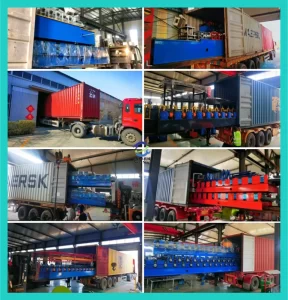
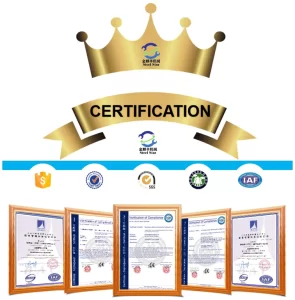
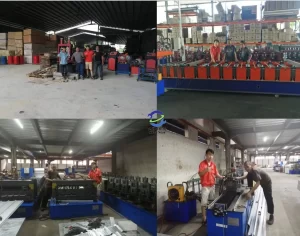
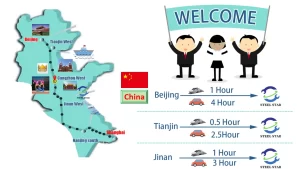
Factory Information:


Website:
www.greatforming.com (English)
www.arabicgreatforming.com (عربي)
www.russiangreatforming.com(Русский)
www.spanishgreatforming.com(Español)
www.frenchgreatforming.com(Français)
www.portuguesegreatforming.com(Portuguese)