

If you are interested in the product and want more information, please leave your information .

WeChat (China) : +86 15075780050
Email : sam@greatforming.com
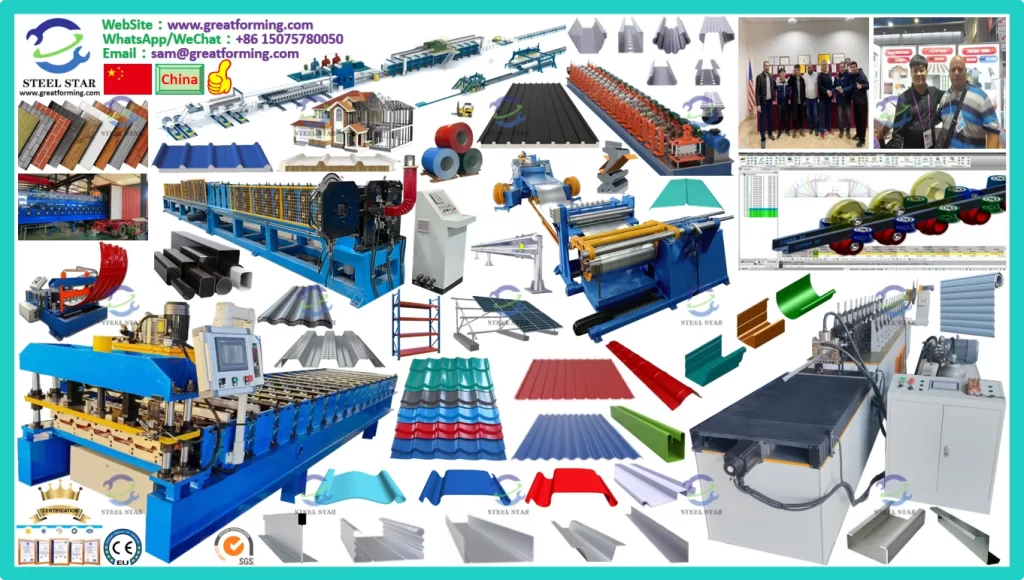
Below is a brochure of our factory products, which can be viewed and downloaded.
Roll forming is a type of rolling that involves continuously bending long strips of metal sheet (typically coiled steel) into the desired cross-section.
Design the mold shape and number of groups according to the required size. The shrinkage ratio of each group of cold bending is different. Through cold bending group by group, the final desired size can be achieved. Combined with electronic control system, hydraulic system, shearing system and counting encoder to realize automated operation.
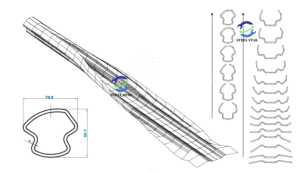
Technical Parameters :
- Raw material width : 200mm — 1000mm (Can be customized according to your needs)
- Thickness of sheet : 0.4mm — 4mm (Can be customized according to your needs)
- speed : 5 m — 20 m/min (Can be customized according to your needs)
- Voltage : 380v 50hz 3phase / 220v 60hz 3phase (Can be customized according to your needs)
- Language : English / Spanish / Arabic / Russian / Portuguese / German / French (Can be customized according to your needs)
- Material of rollers : Gcr15 / Cr12 / Cr12 Mov (Can be customized according to your needs)
- Motor brand : Siemens / other (Can be customized according to your needs)
- Electronic control PLC : Siemens / Delta / other (Can be customized according to your needs)
- Number of roller rows: According to product design
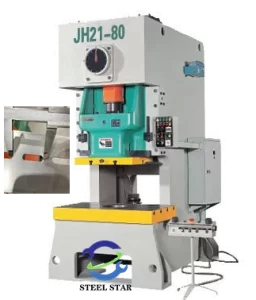
- Punching Press:80 T
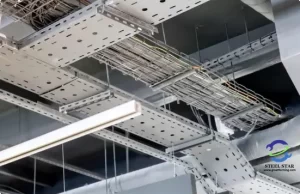
Application Scenarios :
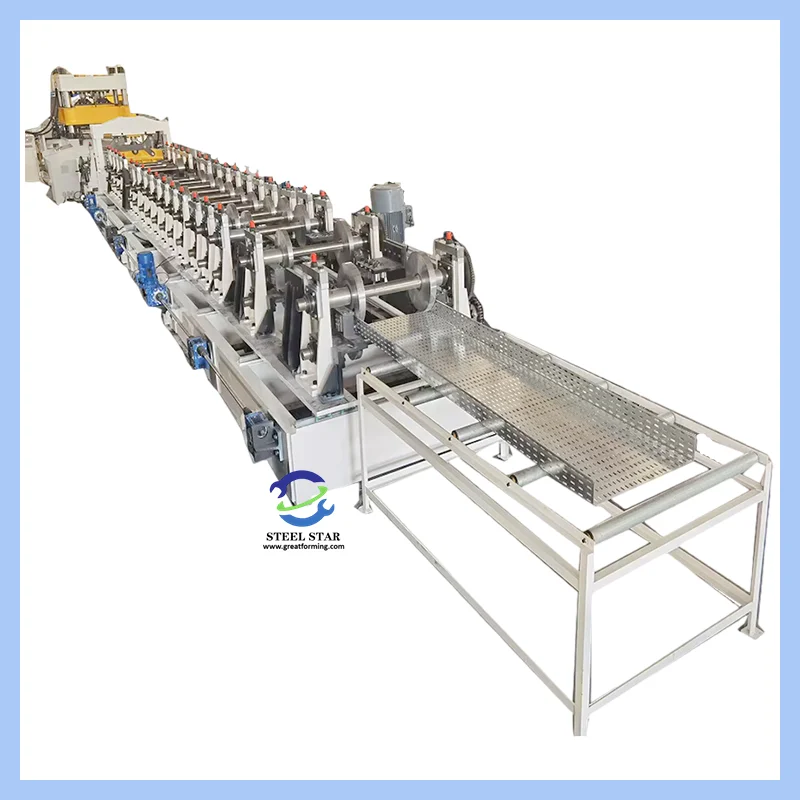
Equipment Production Line:
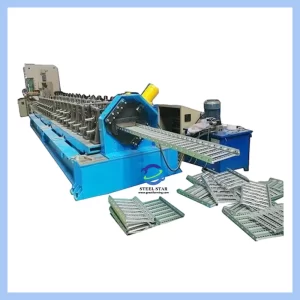
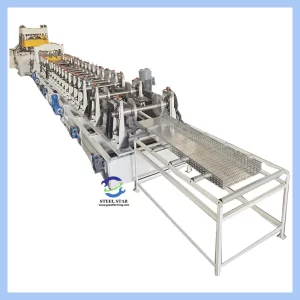
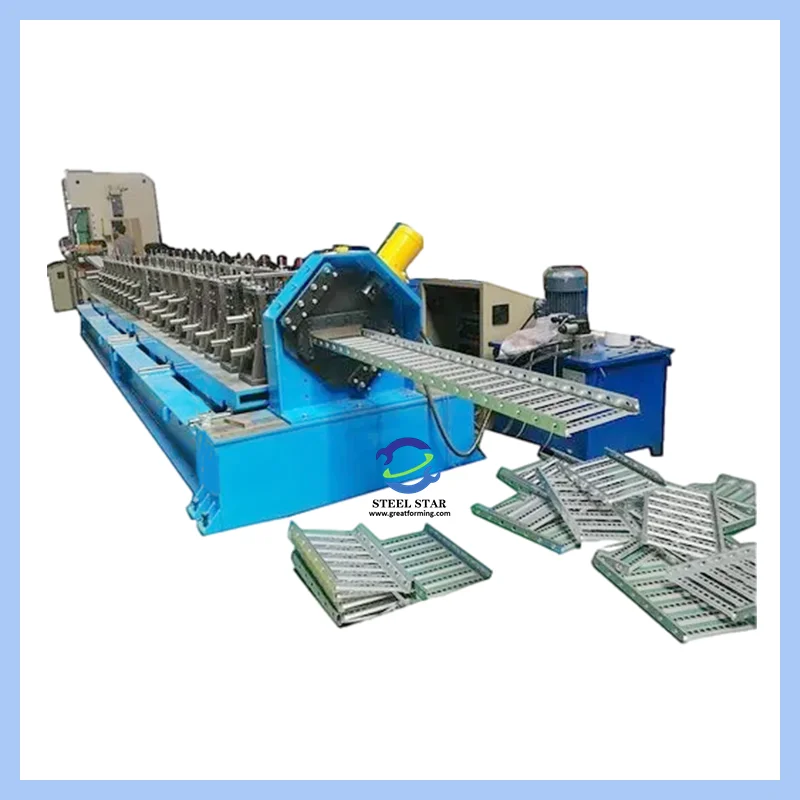
The Backbone of Cable Management: An Overview of the Cable Tray Roll Forming Machine
In the world of commercial and industrial construction, the efficient organization and protection of electrical wiring is paramount. This critical task falls to **cable tray systems**—rigid structural units used to securely fasten and support cables and raceways . Behind the mass production of these essential components lies a sophisticated piece of engineering: the **Cable Tray Roll Forming Machine**.
This article delves into the intricacies of this equipment, exploring its function, the manufacturing process, and the technological advancements that make it a cornerstone of modern electrical infrastructure.
What is a Cable Tray Roll Forming Machine?
A cable tray roll forming machine is a specialized production line designed to transform flat metal coils into finished cable tray sections of specific profiles and lengths . It is a continuous, automated process that bends, folds, and cuts metal with high precision and efficiency . These machines are capable of handling a variety of materials, including **galvanized steel, stainless steel, aluminum, and coated coils (PPGI/PPGL)** , allowing manufacturers to produce trays suited for different environments, from indoor data centers to corrosive outdoor settings .
The Roll Forming Process: From Coil to Finished Product
The transformation of a flat steel coil into a rigid cable tray involves a series of precisely coordinated steps. A typical production line follows this workflow :
1. Decoiling and Leveling: The process begins with a **hydraulic decoiler** that holds and uncoils the heavy metal coil . The material then passes through a leveler, which flattens the metal to ensure a consistent surface for accurate forming .
2. Pre-Punching (Optional): Before forming, many machines utilize a **hydraulic punching press** to create perforations, mounting holes, or slots. This step is crucial for producing perforated cable trays (for ventilation) or for creating specific fitting features .
3. Roll Forming: The flattened and punched strip enters the main roll forming station. Here, it passes through a series of rollers and dies arranged in sequential stations . Each set of rollers progressively bends the metal, gradually shaping it into the final cable tray profile, whether it be a ladder-type, solid-bottom, channel, or trough design . The rollers are typically made of high-grade steel like **45# steel with hard chrome plating or Cr12 steel** for durability and precision .
4. Cutting to Length: Once formed, the continuous profile reaches a **hydraulic cutting press**. The machine cuts the profile to predetermined lengths. This cut is often performed on the fly to maintain production speed and is controlled by a **Programmable Logic Controller (PLC)** for high accuracy .
5. Run-Out and Stacking: The finished cable tray sections are conveyed to a **run-out table**, where they are inspected and prepared for packaging or stacking .
Types and Customization Capabilities
One of the greatest advantages of modern cable tray roll forming machines is their versatility. They can be configured to produce a wide array of tray types to meet diverse project specifications :
Solid Bottom Cable Trays: For maximum cable protection.
Ladder Type Cable Trays: For ventilation and support in high-capacity runs.
Perforated Cable Trays: For ventilation and drainage.
Channel and Trunking Trays: For smaller branch runs.
Wire Mesh Trays: For flexible cable support.
Advanced machines offer significant customization options. For instance, some models allow the operator to input dimensions via a **touchscreen interface**, and the machine will automatically adjust its width and height settings to produce different tray sizes without manual retooling . Others can produce both the tray and its corresponding cover on the same line, saving floor space and reducing costs .
Key Features and Technological Advancements
Modern cable tray roll forming machines are equipped with features that enhance productivity, precision, and safety:
PLC Control Systems: The heart of the modern machine is the **PLC and HMI (Human-Machine Interface)** . This allows for precise control over the forming length, punching patterns, and production speed. It can store multiple recipes for different tray profiles and automatically count finished pieces .
High-Speed Production: Depending on the material thickness and profile complexity, these machines can achieve forming speeds ranging from **10 to 30 meters per minute** . Some advanced models boast speeds up to **20-35% faster than traditional equipment** .
Material Versatility: High-quality machines are built to handle a broad spectrum of material thicknesses, typically from **0.4 mm up to 3.0 mm or even 5.0 mm** in heavy-duty configurations .
Durable Tooling: To withstand the high stresses of forming metal, the rollers and cutting dies are manufactured using CNC precision machines and undergo thermal treatment. Cutting dies, often made from **SKD11 or Cr12 mould steel**, are hardened to **55-62°C HRC** to ensure long life and clean cuts .
Hydraulic Systems: Robust hydraulics power the punching and cutting operations, providing the necessary force for clean and accurate results, especially in thicker materials .
Applications and Conclusion
The output of a cable tray roll forming machine is a fundamental component of modern infrastructure. These cable trays are essential in **commercial buildings, industrial plants, data centers, power generation facilities, and telecommunications networks** . They provide a safe, accessible, and organized pathway for critical power and data cables.
In conclusion, the **Cable Tray Roll Forming Machine** is far more than just a bending apparatus. It is a highly sophisticated, automated production system that combines mechanical engineering with advanced computer control. By efficiently and precisely converting raw metal into vital cable support structures, it plays an indispensable role in building the framework for the world’s electrical and communication systems.
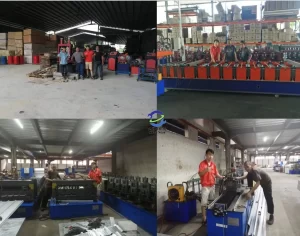
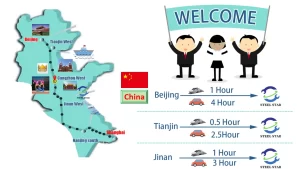
Factory Information:

Website:
www.greatforming.com (English)
www.arabicgreatforming.com (عربي)
www.russiangreatforming.com(Русский)
www.spanishgreatforming.com(Español)
www.frenchgreatforming.com(Français)
www.portuguesegreatforming.com(Portuguese)