

If you are interested in the product and want more information, please leave your information .

WeChat (China) : +86 15075780050
Email : sam@greatforming.com
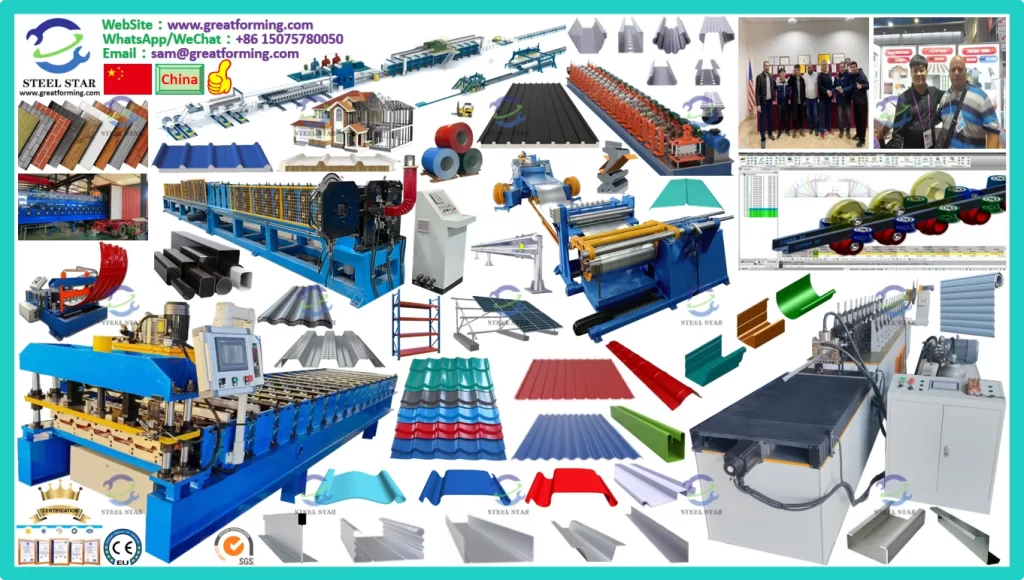
Below is a brochure of our factory products, which can be viewed and downloaded.
Roll forming is a type of rolling that involves continuously bending long strips of metal sheet (typically coiled steel) into the desired cross-section.
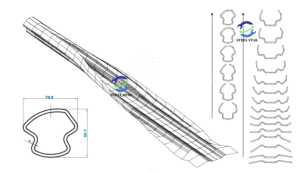
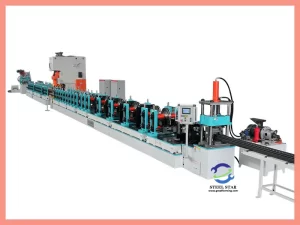
Design the mold shape and number of groups according to the required size. The shrinkage ratio of each group of cold bending is different. Through cold bending group by group, the final desired size can be achieved. Combined with electronic control system, hydraulic system, shearing system and counting encoder to realize automated operation.
Technical Parameters :
- Raw material width : 100mm — 800mm (Can be customized according to your needs)
- Thickness of sheet : 1mm — 3mm (Can be customized according to your needs)
- speed : 5 m — 20 m/min (Can be customized according to your needs)
- Voltage : 380v 50hz 3phase / 220v 60hz 3phase (Can be customized according to your needs)
- Language : English / Spanish / Arabic / Russian / Portuguese / German / French (Can be customized according to your needs)
- Material of rollers : Gcr15 / Cr12 / Cr12 Mov (Can be customized according to your needs)
- Motor brand : Siemens / other (Can be customized according to your needs)
- Electronic control PLC : Siemens / Delta / other (Can be customized according to your needs)
- Number of roller rows: According to product design
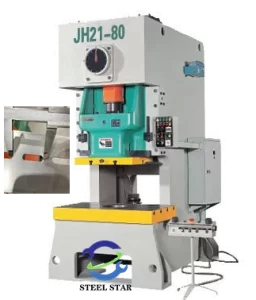
- Punching Press:80 T
Application Scenarios :
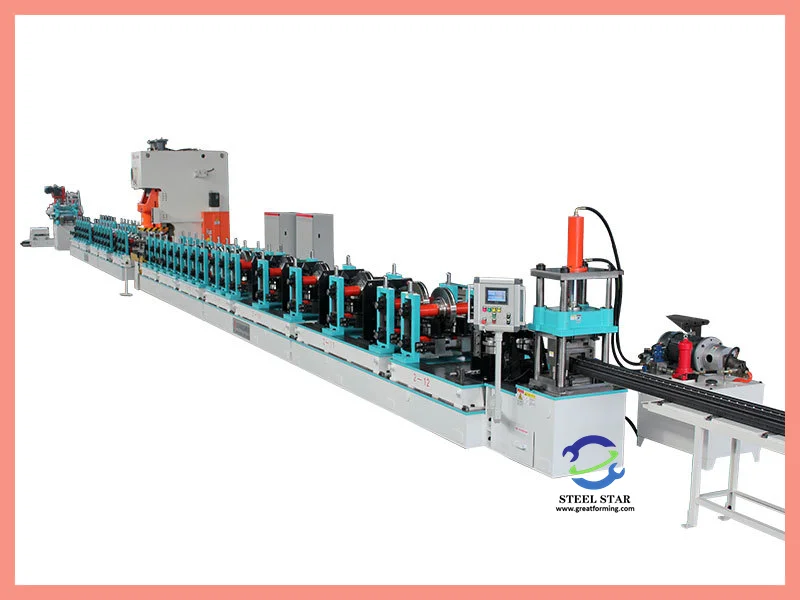
Equipment Production Line:
The Architecture of Order: A Deep Dive into the Racking Roll Forming Machine
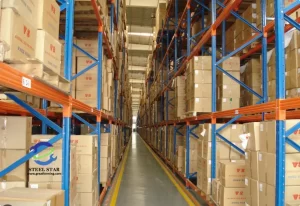
In the vast, organized landscapes of modern warehouses and distribution centers, **pallet racks** and **storage shelving** are the unsung heroes. They transform empty floor space into vertical fortresses of inventory, enabling the efficiency of global logistics. At the heart of manufacturing these critical structures lies a sophisticated piece of industrial equipment: the **Racking Roll Forming Machine**.
Also known as a Pallet Rack, Storage Rack, or Shelf Roll Forming Machine, this equipment is purpose-built to convert steel coils into the high-strength, precision components that form the backbone of storage systems . This article explores the intricacies of these machines, their production capabilities, and the technology that drives modern warehousing.
What is a Racking Roll Forming Machine?
A racking roll forming machine is a continuous, automated production line designed to manufacture the various profiles required for storage rack systems . Unlike standard roll formers, these machines are engineered to handle the thicker, high-strength steel (typically **1.0 mm to 3.5 mm**) necessary to support heavy loads . The process is highly efficient, transforming a flat coil of steel into finished, cut-to-length rack components in a single, seamless operation .
These systems are versatile, capable of producing a wide array of profiles by simply adjusting the rollers or tooling, making them indispensable for manufacturers of logistics and warehouse equipment .
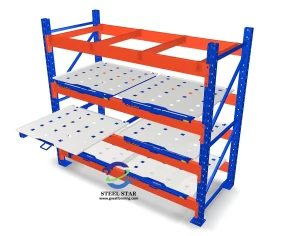
Key Components of a Storage Rack System
Racking roll forming machines are typically dedicated to producing one of two primary structural elements, each serving a distinct purpose in a shelving unit.
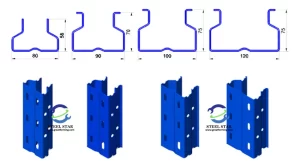
1. Upright Columns (Uprights)
The uprights are the vertical support posts of a racking system. They feature a complex cross-section—often with returns and stiffening ribs—to provide maximum strength and resistance to buckling under heavy loads . These profiles must be manufactured with extreme precision, as they have a pre-punched pattern of holes along their length to allow for beam adjustments .
Material Thickness: Typically **1.3 mm to 3.0 mm** .
Key Features: Continuous hole punching, complex roll forming stations, high straightness tolerance.
2. Step Beams / Crossbeams
The horizontal beams that span between uprights, onto which pallets or shelves are placed, are known as step beams or crossbeams . These profiles often have a distinctive “step” or “C” shape designed to securely lock into the uprights. Safety and stability are paramount, so the manufacturing process may include integrated spot welding or clinching to reinforce critical joints .
Material Thickness: Typically **1.2 mm to 1.6 mm** .
Key Features: Spot welding unit, complex end-notch cutting, high precision in locking mechanisms.
3. Shelf Panels / Decks
For shelving units, solid or slotted decking panels are required. These are often produced on dedicated lines that integrate riveting or clinching stations to assemble multiple pieces or create reinforced edges without the need for visible fasteners .
Material Thickness: Typically **0.7 mm to 0.8 mm** .
Key Features: Width adjustability, integrated riveting/clinching, both-end bending and cutting.
The Manufacturing Process: From Coil to Component
The journey from raw steel to a finished rack component is a symphony of precision engineering, typically controlled by a central Programmable Logic Controller (PLC) . A standard production line follows this workflow:
1. Decoiling and Leveling: The process begins with a hydraulic or manual decoiler that holds and uncoils the heavy steel coil . The strip then passes through a leveling unit, which flattens the metal to eliminate internal stresses and ensure a perfectly flat surface for accurate forming .
2. Pre-Punching and Notching: Before the steel is formed, it enters a hydraulic punching station. This is a critical step for racking components. Here, the machine punches all necessary holes, slots, and dimple notches with high precision . The punching dies, typically made from hardened **Cr12MoV or SKD11 steel (HRC 58-62°)** , are controlled by the PLC to ensure hole patterns align perfectly with the profile’s final shape .
3. Roll Forming: The prepared strip then passes through the roll forming section—a series of progressive roller stands (often **16 to 36 stations**) . Each stand incrementally bends the metal, gradually shaping the flat strip into the complex final profile of an upright or beam. The rollers, often made from **GCr15 bearing steel or Cr12 steel** and precision-machined, ensure consistent shape and tight tolerances .
4. Integrated Assembly (Optional): For certain components like shelf panels or reinforced beams, additional inline processes occur. This can include **servo-controlled spot welding** for beam reinforcement or **riveting/clinching** for assembling multi-piece shelf decks .
5. Cutting to Length: Once formed, the continuous profile is cut to the specified length. A flying saw or hydraulic cutting press, synchronized with the line speed, makes the cut “on the fly” without stopping the process . For beams, this station may also perform simultaneous double bending or notching at both ends .
6. Run-Out and Stacking: The finished, precision-cut components are conveyed to a run-out table or an automatic stacker, where they are collected and prepared for packaging .
Key Features and Technological Advancements
Modern racking roll forming machines are distinguished by features that ensure durability, precision, and high productivity:
Heavy-Duty Construction: To handle thick, high-strength steel (up to **550 MPa yield strength**), the machine frames are robust, and drive shafts are often solid steel (e.g., **75mm to 82mm diameter**) machined to tight tolerances .
Advanced PLC and HMI Control: The central control system is the brain of the operation. Operators use a touchscreen Human-Machine Interface (HMI) to input production data like part length, number of pieces, and punching patterns. The **PLC (often Mitsubishi, Siemens, or Panasonic)** automatically manages the line speed, punching sequence, and cut-off length, ensuring repeatable precision and allowing for “single-person operation” .
High-Precision Tooling: The quality of the final product depends on the tooling. Punches and dies are made from high-chrome or alloy steel, heat-treated for hardness, and machined on CNC equipment. Roller runout is often maintained within **±0.03mm** to ensure profile consistency .
Integrated Inline Processes: The most efficient machines combine multiple manufacturing steps into one line. Pre-punching, notching, embossing, spot welding, clinching, and cutting are all performed inline, eliminating secondary operations, reducing labor costs, and increasing throughput .
Flexibility and Quick Changeovers: Many machines feature adjustable widths or quick-change cartridge systems for the rollers, allowing manufacturers to switch between different profile sizes with minimal downtime .
Applications and Conclusion
The output of a racking roll forming machine is essential to virtually every sector of the modern economy. From massive **distribution centers for e-commerce giants** to the compact **shelving in local retail shops**, and from **industrial warehouses** storing heavy machinery parts to **automotive parts warehouses** , these racking systems provide the necessary organization and efficiency. Specialized machines can even produce components for **server cabinets** in data centers, highlighting the versatility of this technology
In conclusion, the **Racking Roll Forming Machine** is a pinnacle of manufacturing efficiency. It is a complex system where heavy-duty mechanical engineering meets sophisticated computer control. By precisely and continuously transforming raw steel into the fundamental building blocks of storage, it does more than just make products—it enables the very architecture of order that keeps the world’s goods flowing.
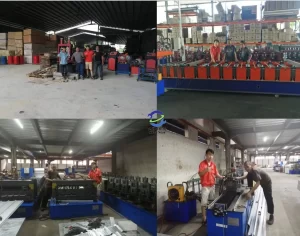
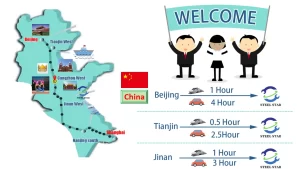
Factory Information:


Website:
www.greatforming.com (English)
www.arabicgreatforming.com (عربي)
www.russiangreatforming.com(Русский)
www.spanishgreatforming.com(Español)
www.frenchgreatforming.com(Français)
www.portuguesegreatforming.com(Portuguese)