

If you are interested in the product and want more information, please leave your information .

WeChat (China) : +86 15075780050
Email : sam@greatforming.com
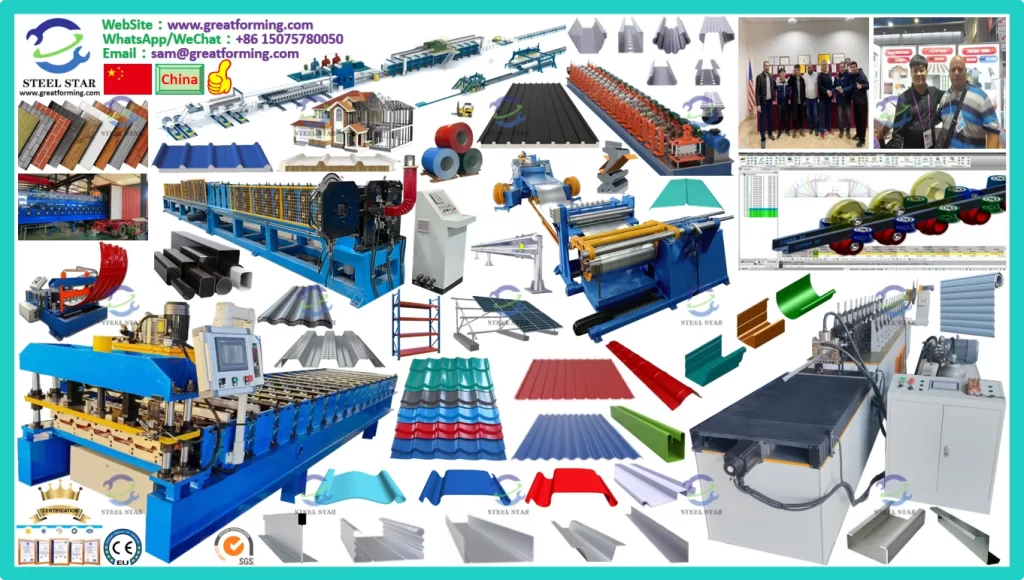
Below is a brochure of our factory products, which can be viewed and downloaded.
Roll forming is a type of rolling that involves continuously bending long strips of metal sheet (typically coiled steel) into the desired cross-section.
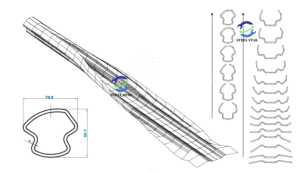
Design the mold shape and number of groups according to the required size. The shrinkage ratio of each group of cold bending is different. Through cold bending group by group, the final desired size can be achieved. Combined with electronic control system, hydraulic system, shearing system and counting encoder to realize automated operation.
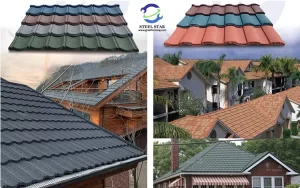
Application Scenarios :
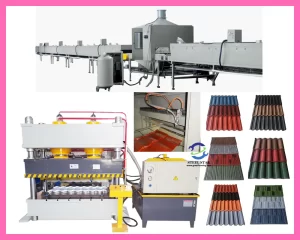
Equipment Production Line:
The Complete Guide to Stone Coated Roof Tile Making Machines
In the modern construction industry, the demand for roofing materials that combine aesthetic appeal with exceptional durability has never been higher. At the heart of this trend lies the **stone coated roof tile making machine**—a specialized manufacturing system that produces high-quality, weather-resistant roofing tiles by applying natural stone granules to metal substrates . This article provides a comprehensive overview of these machines, exploring their technology, specifications, and applications.
What is a Stone Coated Roof Tile Making Machine?
A stone coated roof tile making machine is an industrial production line designed to manufacture roofing tiles that feature a metal core (typically galvanized steel or aluminum-zinc alloy) coated with a layer of colored stone granules. The resulting product combines the strength and flexibility of metal with the natural beauty and thermal properties of stone .
These machines are essential for producing tiles that offer superior resistance to UV radiation, corrosion, and impact, making them ideal for residential, commercial, and industrial applications across diverse climatic conditions .
The Production Process: From Coil to Finished Tile
Understanding the manufacturing process is crucial for appreciating the complexity and capability of these machines. A typical stone coated roof tile production line consists of several integrated stages :
1. Raw Material Preparation
The process begins with aluminum-zinc steel coils (composed of 55% aluminum, 43.4% zinc, and 1.6% silicon), which are inspected for quality and coating content. This material offers 2–6 times the lifespan of standard galvanized steel .
2. Uncoiling and Cutting
The steel coil is loaded onto an uncoiler and fed into the machine, where precision cutting equipment trims it to predetermined dimensions .
3. Stamping and Forming
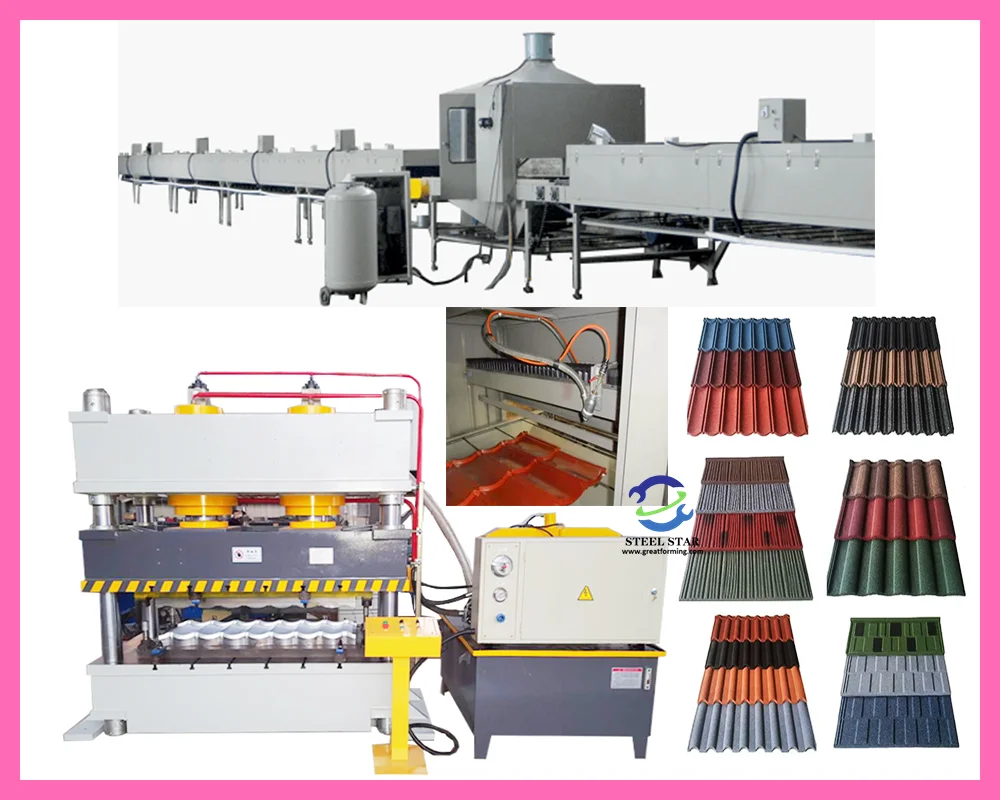
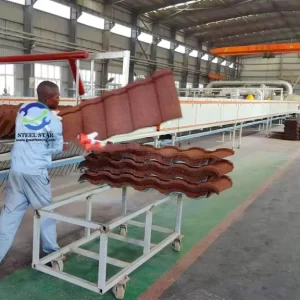
Hydraulic press systems with specialized molds shape the cut sheets into specific tile profiles—such as classical, roman, or shingle designs—while trimming ensures clean, even edges .
4. Adhesive Application
An anti-fingerprint coating is first applied to protect the metal and enhance adhesion. Then, a base layer of acrylic adhesive is evenly sprayed onto the formed steel sheet .
5. Stone Granule Application
While the adhesive remains wet, sintered colored stone granules (made from basalt and available in over 30 colors) are uniformly applied to the surface .
6. Top Coating and Curing
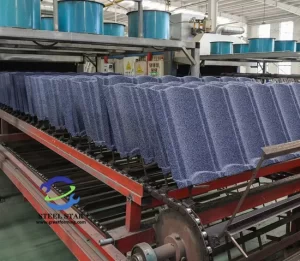
A final acrylic adhesive layer is sprayed over the granules to lock them in place. The tiles then pass through drying ovens—typically at temperatures around 200°C for 15–20 minutes—to fully cure the adhesive and ensure permanent bonding .
7. Inspection and Packaging
Finished tiles undergo rigorous quality checks for adhesion, color consistency, and dimensional accuracy before being packaged for shipment .
Types of Stone Coated Tile Making Machines
Manufacturers can choose from various machine configurations based on their production scale, automation needs, and product requirements :
By Production Capacity
Small-Scale Machines: Produce 500–1,500 tiles/day; ideal for startups and local workshops with lower initial investment.
Medium-Scale Machines: Output 1,500–4,000 tiles/day; suitable for regional suppliers and growing operations.
Large-Scale Machines: Capable of 4,000+ tiles/day; designed for industrial manufacturers with full automation .
By Automation Level
Semi-Automatic Machines: Combine manual loading with automated forming and coating; lower cost and easier maintenance.
Automatic Machines: Feature PLC control systems with touchscreen interfaces, automated feeding, cutting, and stacking; reduce labor costs and ensure consistent quality .
By Manufacturing Process
Granule-Coated Tile Machines: Embed stone granules into resin-coated metal sheets for lightweight, corrosion-resistant tiles.
Stone-Coated Concrete Tile Machines: Press concrete into molds with stone chip finishes for heavier, fire-resistant applications .
Key Technical Specifications
When evaluating a stone coated roof tile making machine, several critical parameters should be considered :
| Specification | Typical Range | Considerations |
| Production Speed | 10–25 m/min or 500–2,000 tiles/hour | Higher speed for mass production; ensure consistent quality at rated output |
| Material Thickness | 0.3–0.7 mm (metal base) | Match to regional requirements (thicker for high-wind/snow areas) |
| Power Supply | 380V/50Hz (3-phase) or 220V/60Hz | Verify compatibility with local electrical infrastructure |
| Hydraulic Pressure | 12–20 MPa | Critical for precise shaping and embossing |
| Machine Dimensions | Length: 35–70 meters | Ensure adequate workshop space; some lines can be split for shorter spaces |
| Control System | PLC with touchscreen interface | Enables real-time parameter adjustment and diagnostics |
Applications and Market Demand
Stone coated roof tile making machines serve a diverse range of construction sectors :
Residential Roofing: Lightweight, aesthetically pleasing tiles for homes, villas, and apartment buildings.
Commercial Construction: Durable solutions for offices, shopping centers, and industrial facilities.
Renovation Projects: Particularly suited for “flat-to-pitch” conversions and roof overlays, as tiles can often be installed over existing roofing without removal .
Architectural Heritage: Concrete-based stone-coated tiles offer authentic appearance for traditional and heritage buildings.
The finished tiles boast impressive performance characteristics: they are resistant to extreme temperatures (-50°C to 70°C), fire, impact, and corrosion, with lifespans exceeding 50 years under proper conditions .
Maintenance and Operational Considerations
To maximize machine lifespan and production quality, regular maintenance is essential :
Daily: Clean adhesive spray nozzles, inspect conveyor chains, check hydraulic fluid levels.
Weekly: Calibrate temperature controllers, inspect rollers for wear, verify adhesive viscosity.
Monthly: Perform comprehensive PLC system diagnostics, inspect electrical connections, lubricate moving parts.
Annually: Conduct full system overhaul, replace worn components, recalibrate sensors.
Investing in operator training and following manufacturer maintenance schedules can significantly reduce downtime and protect return on investment .
The stone coated roof tile making machine represents a sophisticated intersection of material science, mechanical engineering, and construction technology. By enabling the efficient production of tiles that combine metal’s structural advantages with stone’s aesthetic and protective qualities, these machines have become indispensable to modern roofing manufacturing.
Whether for a small startup seeking entry into the roofing market or a large industrial operation aiming to maximize output, selecting the right machine involves careful consideration of production capacity, automation level, and technical specifications. With proper selection and maintenance, these systems deliver consistent, high-quality roofing solutions that meet the evolving demands of the global construction industry.
For businesses looking to invest, suppliers on platforms like Alibaba and Made-in-China offer a wide range of models, with customization options to suit specific production goals and budget constraints .
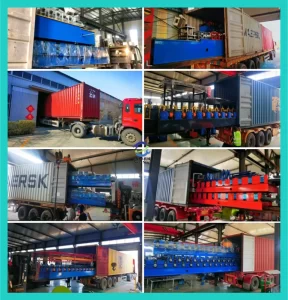
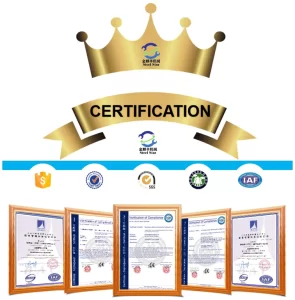
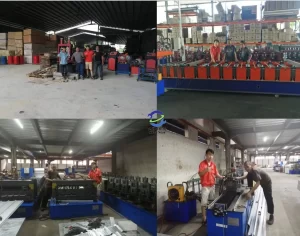
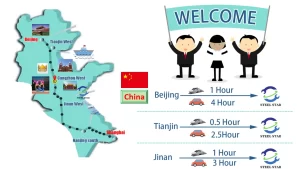
Factory Information:


Website:
www.greatforming.com (English)
www.arabicgreatforming.com (عربي)
www.russiangreatforming.com(Русский)
www.spanishgreatforming.com(Español)
www.frenchgreatforming.com(Français)
www.portuguesegreatforming.com(Portuguese)