

The Silent Guardian: An In-Depth Look at Guardrail Roll Forming Machines
Beneath the surface of our vast and complex transportation infrastructure lies a critical and often overlooked line of defense: the highway guardrail. This simple yet ingeniously engineered component, designed to absorb impact energy and redirect errant vehicles, is a cornerstone of road safety worldwide. At the heart of its mass production stands a specialized piece of industrial equipment: the Guardrail Roll Forming Machine. This machine embodies the precision, strength, and consistency required to manufacture a product where reliability is not just a preference but a life-saving imperative.
Core Function and Principle
A guardrail roll forming machine is a heavy-duty, continuous cold roll forming system engineered to transform high-strength steel coil into the specific, standardized profiles mandated for roadside safety barriers. Unlike simple bending, the process involves progressive, plastic deformation through a series of roller dies to create complex cross-sections with exceptional structural integrity.
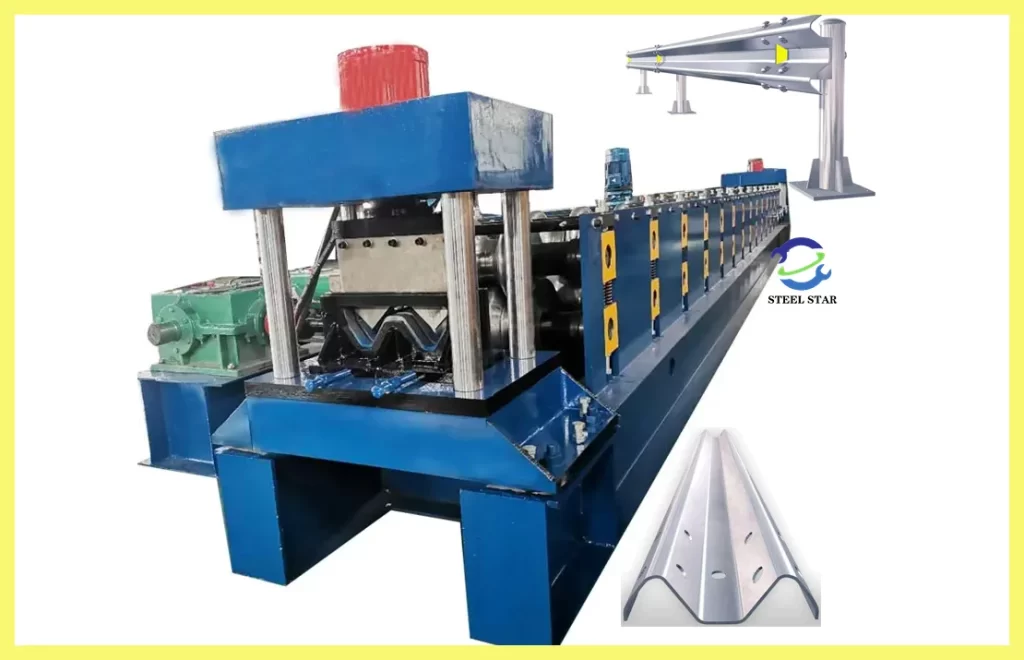
The production sequence follows a tightly controlled, automated flow:
- Material Feeding: Large coils of raw steel, typically SAE 1020 or similar grades with a yield strength of 550 MPa or higher, are loaded onto a heavy-duty decoiler.
- Precision Leveling: The steel strip passes through a multi-roll leveler. This step is crucial for eliminating coil set and internal stresses, ensuring a perfectly flat strip enters the forming process. This guarantees the geometric accuracy and straightness of the final guardrail.
- The Roll Forming Mill: This is the machine’s core. The flat steel strip is guided through a cascading series of tandem roll stands (typically 12 to 20+ stations). Each stand contains a pair of precision-machined, hardened steel rollers. Each subsequent station incrementally bends the metal by a precise degree, gradually shaping it into the final W-beam, Thrie-beam, or box-beam profile without removing any material. This cold-working process enhances the steel’s strength.
- Post-Forming Operations:
- Punching: An integrated, high-tonnage servo-hydraulic punching unit punches the precisely spaced bolt holes required for splicing sections together in the field. Hole location accuracy is paramount for proper assembly and tension.
- Cut-Off: A high-precision, synchronized flying cut system (hydraulic or servo) shears the continuous formed guardrail to exact standard lengths (commonly 12.5 ft / 3.81 m or other specified lengths) without stopping production.
- Run-Out & Handling: The finished guardrail sections are conveyed to a run-out table and often automatically stacked or bundled for galvanization, painting, or direct shipment.
Key Components and Technical Demands
- Heavy-Duty Structural Frame: Built to withstand immense forming forces with minimal deflection, ensuring profile consistency over thousands of meters.
- High-Precision Forming Rollers: Manufactured from high-grade alloy steel (e.g., Cr12MoV) and heat-treated for extreme wear resistance. The roller design is the proprietary key to achieving the exact profile geometry required by national standards (e.g., AASHTO M180, EN 1317).
- Robust Punching System: Equipped with guided tooling and often automatic lubrication to maintain hole quality and tool life under high-impact loads.
- Advanced CNC Control System: A Programmable Logic Controller (PLC) synchronizes all motions—feed speed, punch timing, and cut-off length. Modern systems feature Human-Machine Interface (HMI) touchscreens for recipe storage and production monitoring.
The Critical Advantages of Roll Forming for Guardrails
- Unmatched Consistency: Every meter of guardrail produced has identical mechanical properties and dimensions, which is non-negotiable for predictable crash performance.
- High-Volume Efficiency: Enables continuous production at speeds of 15-40 meters per minute, meeting the massive demands of highway departments and infrastructure projects globally.
- Superior Strength & Quality: The cold-forming process work-hardens the steel, and the continuous grain flow in the final product enhances its energy-absorption capacity—a vital characteristic for impact resistance.
- Material Efficiency: The process generates near-zero scrap aside from the coil ends, optimizing the use of high-strength steel.
Profile Diversity and Applications
These specialized machines produce the primary components of roadside and median safety systems:
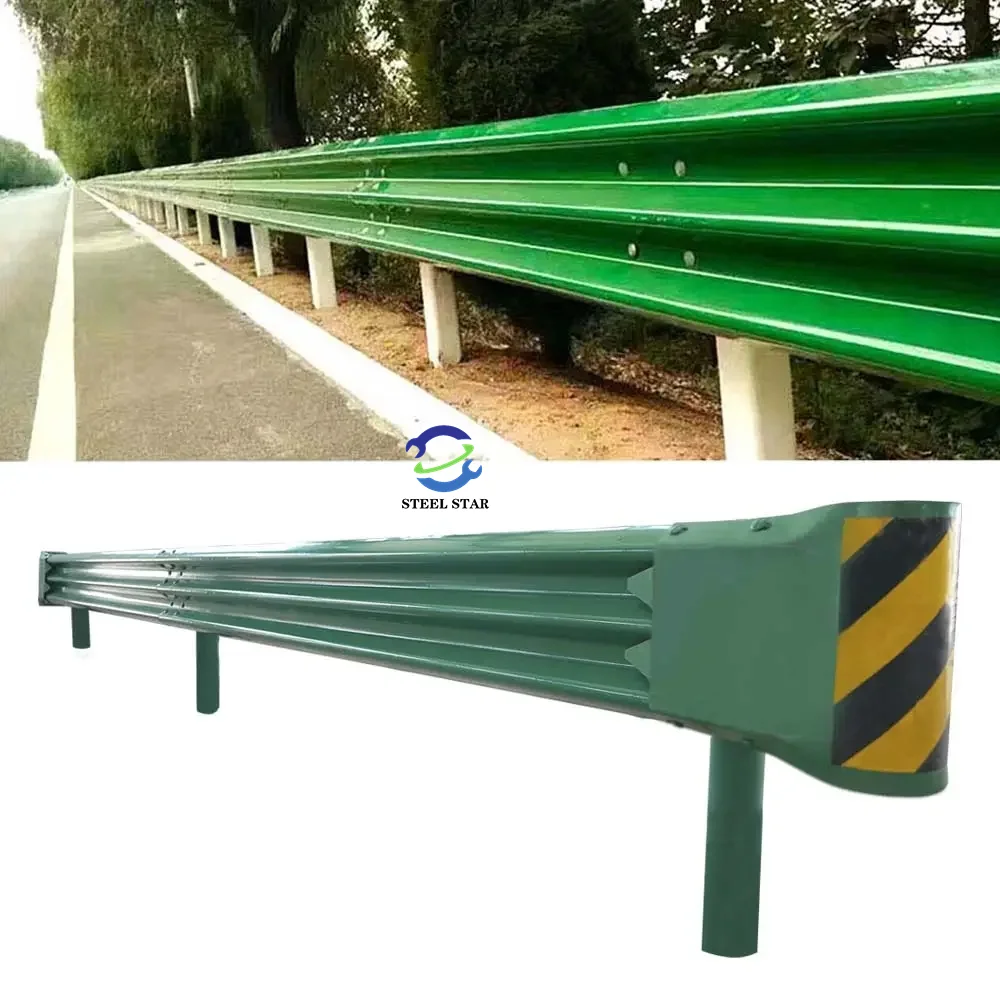
- W-Beam Guardrail: The most common “corrugated” profile, designed to crumple and redirect vehicles.
- Thrie-Beam Guardrail: A taller, three-corrugation profile for higher containment needs, often used on medians or for heavy vehicles.
- Box Beam Guardrail: A rectangular or square hollow section used in high-impact areas and bridge parapets.
- Posts and Brackets: Complementary roll forming lines produce the supporting U-channel or C-section posts and block-out brackets.
Evolution and Future Outlook
Guardrail manufacturing technology continues to advance, focusing on:
- Enhanced Automation & IoT: Integration of sensors for real-time monitoring of roll wear, punch force, and dimensional accuracy, enabling predictive maintenance and data-driven quality assurance.
- Handling of Advanced Materials: Adaptation to form newer, ultra-high-strength steels (UHSS) and aluminum alloys for lighter-weight, higher-performance barriers.
- End-to-End Integration: Linking the roll forming line directly with in-line galvanizing, painting, or automated packaging systems for a seamless finished product flow.
The guardrail roll forming machine is a testament to precision engineering in service of public safety. It is far more than a fabrication tool; it is a guarantor of consistency, transforming raw steel into a vital safety device with unerring accuracy. In its relentless, rhythmic production, this machine embodies the silent, steadfast promise of our infrastructure: to protect life. By ensuring that every section of guardrail meets the strictest standards, it plays an indispensable, if unseen, role in safeguarding journeys on roads around the world.
Website:
www.greatforming.com (English)
www.arabicgreatforming.com (عربي)
www.russiangreatforming.com(Русский)
www.spanishgreatforming.com(Español)
www.frenchgreatforming.com(Français)
www.portuguesegreatforming.com(Portuguese)