

The Hydraulic Decoiler: The Essential Powerhouse of Coil Processing Lines
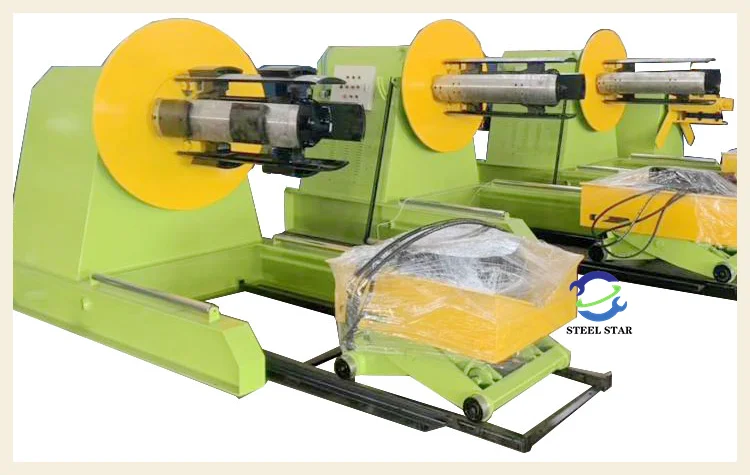
The hydraulic decoiler is a fundamental component in modern coil processing systems, serving as the critical entry point for feeding raw material into production lines such as slitting, blanking, roll forming, and press feeding. Unlike simpler mechanical decoilers, a hydraulic decoiler utilizes a controlled hydraulic system to manage the heavy, powerful forces involved in handling large steel and metal coils, thereby ensuring smooth, safe, and efficient operation.
Core Function and Operating Principle
The primary function of a hydraulic decoiler is to securely hold and unwind a heavy metal coil, providing controlled tension and speed as the strip is fed into the next processing stage. Its operation is based on a closed-loop hydraulic circuit:
- Loading: A coil car or overhead crane places the coil onto the decoiler’s expanding mandrel. The mandrel, with its multiple hydraulic segments, expands radially outward to grip the coil firmly from the inside, preventing slippage and ensuring perfect centering.
- Braking and Tension Control: This is the hydraulic system’s key advantage. As the downstream machine pulls the strip, the decoiler must provide controlled resistance. A hydraulic motor or brake, managed by proportional valves, applies a precise and adjustable back-tension. This prevents the coil from over-running and tangling, maintaining a consistent material loop for stable processing.
- Unwinding: The mandrel rotates as the strip is pulled. Hydraulic power can also be used to assist in the initial unwinding or to rewind slack if needed.
Key Components and Advantages
- Hydraulic Expansion Mandrel: Ensures uniform grip and eliminates damage to the coil’s inner diameter, crucial for maintaining material quality.
- Hydraulic Drive/Brake System: Provides infinitely variable, shock-free tension control. It can handle high inertia from heavy coils smoothly, preventing sudden jerks that could damage the strip or the line.
- Heavy-Duty Construction: Built with robust frames and bearings to support coils weighing from 2 tons to over 50 tons.
- Safety: Integrated hydraulic disc brakes provide a fail-safe holding force, a critical safety feature for handling heavy loads.
The main advantages over mechanical decoilers are:
- Superior Tension Control: Essential for processing high-strength materials and maintaining precise loop control.
- Higher Load Capacity: Capable of handling the heaviest coils used in industry.
- Reduced Maintenance: Hydraulic systems, when properly maintained, are highly reliable with fewer wearing parts than complex mechanical gearboxes.
- Smoother Operation: Hydraulic power allows for cushioned starts and stops, protecting both the material and the machinery.
Types and Configurations
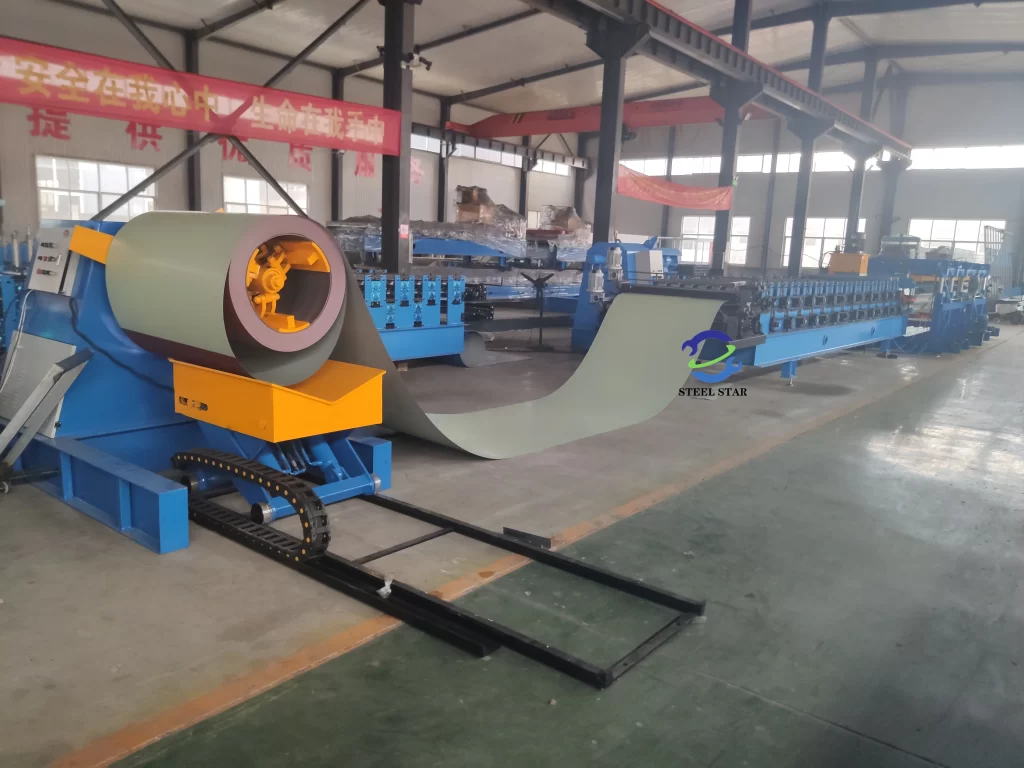
- Single-Mandrel Decoiler: The most common type, featuring one mandrel. It requires the line to be stopped for coil changeover.
- Double-Mandrel (Pivot Arm) Decoiler: Features two mandrels on a rotating arm. While one coil is in production, the next can be loaded. The arm then swings the new coil into position, enabling semi-continuous operation and significantly reducing downtime.
- Motorized Hydraulic Decoiler: Incorporates a hydraulic motor to provide powered unwinding, which is beneficial for very heavy coils or specific tension requirements.
Application and Importance
Hydraulic decoilers are indispensable in any high-volume, precision-oriented metalworking facility. They form the starting point for producing:
- Slit coils for automotive parts, construction, and appliances.
- Blanks for stamping and fabrication.
- Feedstock for roll-formed sections like roofing, purlins, and steel studs.
Their reliability and precise tension control directly impact the quality of the final product, line speed, and overall operational safety.
The hydraulic decoiler is more than just a coil holder; it is an intelligent, powered interface between raw material inventory and the manufacturing process. By combining brute strength with precise hydraulic control, it ensures a stable, consistent material flow that is the foundation of productivity and quality in modern coil processing. When selecting a decoiler, considerations of coil weight, width, material strength, and desired line automation will determine the specific hydraulic configuration required, making it a cornerstone investment for any serious metal processor.
Website:
www.greatforming.com (English)
www.arabicgreatforming.com (عربي)
www.russiangreatforming.com(Русский)
www.spanishgreatforming.com(Español)
www.frenchgreatforming.com(Français)
www.portuguesegreatforming.com(Portuguese)