

The CZ Purlin Roll Forming Machine: Engineering the Backbone of Modern Construction.
Introduction: Defining the Structural Framework
In the realm of modern construction, from vast warehouses and industrial facilities to commercial complexes and aircraft hangars, the need for wide-span, column-free spaces is paramount. This architectural ambition is made possible by a critical structural component: the CZ Purlin. Supporting roof and wall cladding, these steel members transfer loads to primary frames, forming the essential secondary structural skeleton. At the heart of their efficient, precise, and cost-effective production lies a sophisticated piece of industrial equipment: the CZ Purlin Roll Forming Machine.
This machine embodies the principle of cold roll forming, a continuous, high-speed manufacturing process that transforms raw steel coil into complex, high-strength C and Z-shaped profiles with remarkable consistency. This article provides a comprehensive exploration of the CZ purlin machine, detailing its operation, components, technological advancements, and its indispensable role in global construction.
Part 1: Understanding CZ Purlins and Their Significance
What are CZ Purlins?
CZ purlins are thin-walled, cold-formed steel sections. The “C” and “Z” refer to their cross-sectional shapes.
- C-Purlins: Resemble the letter C, with a central web and two flanges, one of which may have a lip for added stiffness. They are commonly used as rafters (roof) or studs (wall) and are often fastened back-to-back or to other members.
- Z-Purlins: Shaped like the letter Z, with a central web and two flanges pointing in opposite directions. This clever design allows them to be lapped at the supports (over rafters), creating a continuous beam that is highly efficient for long-span roof applications. This lapping capability often makes Z-purlins the preferred choice for primary secondary structural elements.
Why are they Preferred?
- High Strength-to-Weight Ratio: Cold-forming increases yield strength. They provide robust support with minimal weight.
- Design Flexibility: Can be easily cut, drilled, and connected on-site to accommodate various architectural designs.
- Material Efficiency & Speed: Roll forming produces minimal waste. Pre-punched holes enable rapid, bolted installation.
- Cost-Effectiveness: Efficient manufacturing and installation reduce overall project time and labor costs.
Part 2: Anatomy of a Modern CZ Purlin Roll Forming Line
A complete production line is a seamlessly integrated system. Here is a breakdown of its core components and their functions:
1. The Decoiling & Feeding System:
The process begins with a heavy-duty decoiler holding a large coil (often 3-5 tons) of pre-galvanized or painted steel strip. An automatic hydraulic mandrel expands to grip the coil’s inner diameter. A cradle or peeler ensures smooth, controlled uncoiling, feeding the material into an entry guide. Advanced lines feature dual decoilers with a stitching table to weld the tail of one coil to the lead of the next, enabling non-stop, continuous production—a critical feature for high-volume output.
2. The Pre-Punching/Pre-Notching Unit (The Game-Changer):
This is arguably the most critical station for structural purlin production. Before the strip enters the roll former, it passes through a CNC-controlled servo punching unit. This powerful press, synchronized with the line speed, punches all necessary holes with extreme precision:
- Bolt Holes: For connecting purlins to the primary structure (rafters/columns).
- Lap/Splice Holes: For connecting purlin sections to each other.
- Service Holes: For utilities and conduits.
- Drainage/Embossment Holes: For condensation control.
Punching before forming (pre-punching) is essential for maintaining hole accuracy, as forming afterward would distort the holes. The CNC system allows for instant pattern changes for different purlin lengths and connection designs.
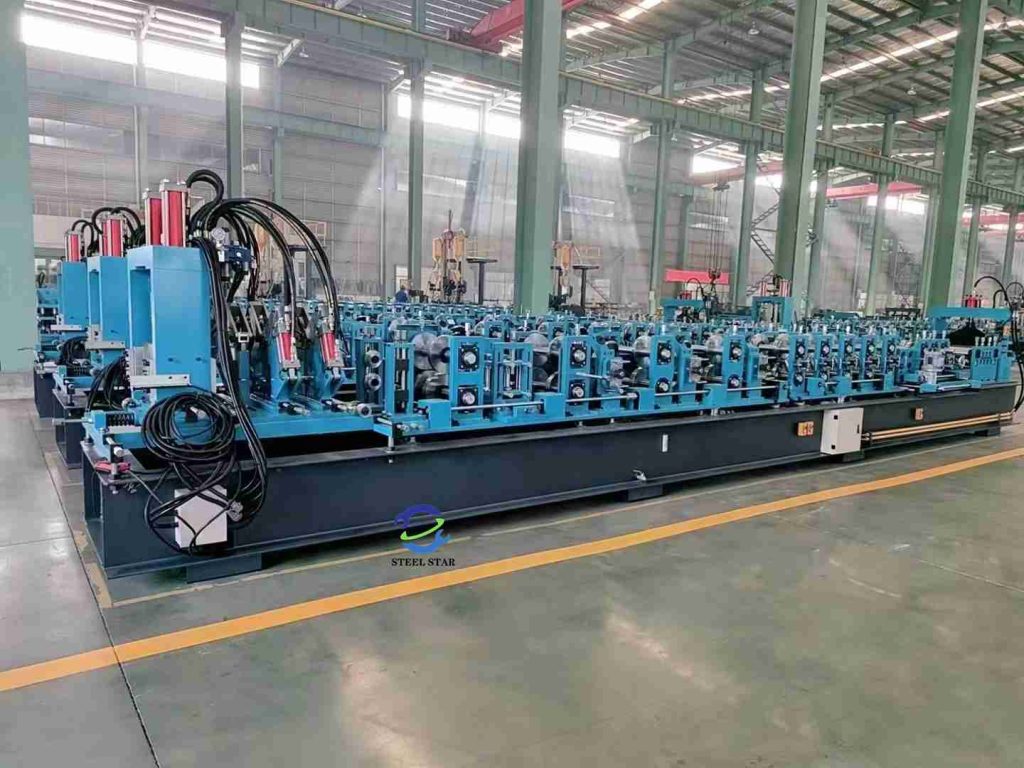
3. The Heart: The Roll Forming Mill
This is where the flat, punched strip is progressively shaped. The mill consists of a series of stand housings, each containing a pair of precision-machined, hardened steel rolls. Driven by a powerful motor via gearboxes and drive shafts (or individual servo motors in advanced systems), these rolls incrementally bend the steel.
- Stations 1-4: Perform initial edge forming and shallow bends.
- Stations 5-12: Gradually form the web and flanges.
- Final Stations (13-20+): Complete the final shape, form the lip (for C-purlins), and ensure the profile meets exact dimensional tolerances. The total number of stations (often 16-22) depends on the profile complexity and desired quality. More stations allow for gentler, more precise forming, reducing stress and springback.
4. The Cut-Off System: Precision at Full Speed
As the fully formed purlin exits the mill continuously, a flying cut-off system shears it to exact lengths. This system, typically hydraulic or servo-electric, moves synchronously with the purlin during the cut. The cut is triggered by a rotary encoder measuring the precise length of material passed. Servo cut-offs offer superior accuracy and speed for complex cutting patterns, including angles for roof slopes.
5. The Output & Stacking System:
The finished, cut-to-length purlins are conveyed on rollers or belts. An automatic stacking system organizes them into pre-determined bundles. A counting and bundling unit then straps the bundles, which are labeled and ready for shipping. This automation minimizes manual handling and damage.
6. The Control Center: PLC and HMI
The entire line is orchestrated by a Programmable Logic Controller (PLC). An operator inputs parameters (profile type, length, quantity, hole pattern) via a Human-Machine Interface (HMI) touchscreen. Modern systems store hundreds of job recipes, allowing for quick changeovers. The PLC synchronizes the decoiler speed, punching unit, roll former, and cut-off with flawless precision.
Part 3: Key Technological Features and Advancements
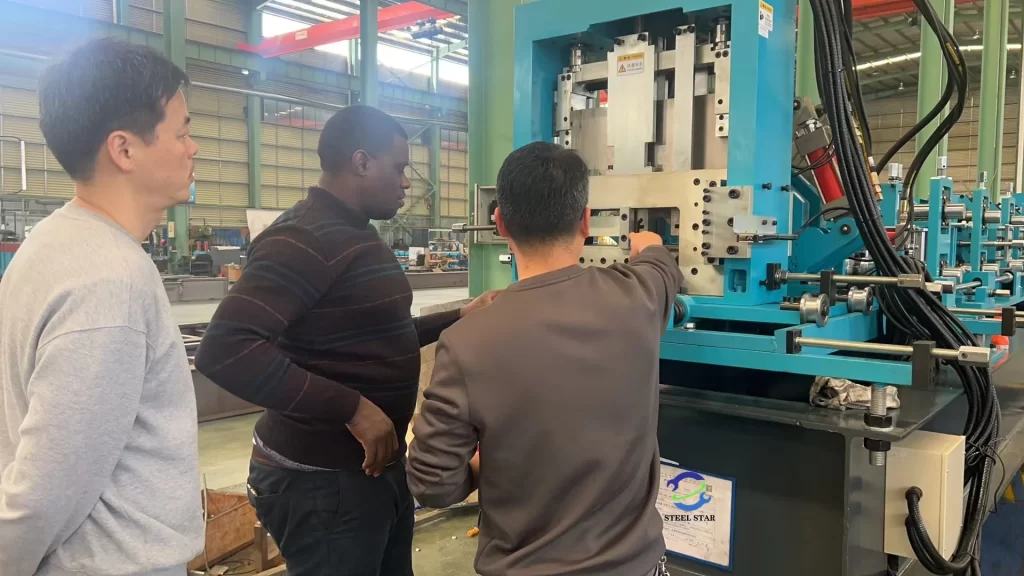
- Quick-Change Tooling Systems: Modern mills allow for the rapid changing of entire roll sets (tooling) to switch between different purlin sizes (e.g., 100mm to 300mm depth) or between C and Z profiles. This drastically reduces downtime and increases line flexibility.
- Servo-Electric Drive Technology: Replacing traditional hydraulic and mechanical drives with individual servo motors for each roll station and the punching unit. This offers unparalleled control, higher energy efficiency, quieter operation, and the ability to dynamically adjust forming parameters on-the-fly.
- In-Line Flange Embossing: Some machines integrate a unit to create dimples or ribs in the purlin flanges. This embossing significantly increases load-bearing capacity and spanning capability by preventing local buckling.
- Industry 4.0 Integration: Machines are now equipped with sensors for predictive maintenance (monitoring roll wear, hydraulic pressure, vibration) and data acquisition systems that track production speed, output, and efficiency for real-time OEE (Overall Equipment Effectiveness) analysis.
Part 4: Applications and Economic Impact
CZ purlins from these machines are ubiquitous in:
- Industrial Buildings: Warehouses, factories, distribution centers.
- Commercial Buildings: Shopping malls, supermarkets, exhibition halls.
- Agricultural Buildings: Barns, storage sheds, machinery halls.
- Aircraft Hangars and Sports Arenas.
The economic impact is profound. By enabling the fast, precise, and waste-minimized production of a fundamental building block, these machines lower the cost of structural frameworks, accelerate project timelines, and enhance the reliability of construction. They empower steel fabricators to bid more competitively and execute projects with greater certainty.
Part 5: Considerations for Fabricators
Investing in a CZ purlin line requires careful analysis:
- Profile Range & Tooling: Defining the required size range (depth, flange width, thickness capacity) is crucial, as tooling is custom and represents a major portion of the investment.
- Material Thickness & Strength: Machines are rated for specific yield strengths (typically up to 550 MPa) and thicknesses (e.g., 1.0mm to 3.0mm).
- Automation Level: Choices between basic, semi-automatic, and fully automatic lines with coil stitching and auto-stacking affect both price and required labor.
- After-Sales Support: Access to technical support, spare parts, and tooling maintenance is vital for long-term productivity.
The CZ Purlin Roll Forming Machine is a masterpiece of applied industrial engineering. It quietly and relentlessly produces the hidden framework upon which vast swathes of our industrial and commercial infrastructure depend. By merging mechanical precision with digital control, it translates raw steel into optimized structural elements with a level of efficiency unattainable by older fabrication methods.
As construction trends continue to favor pre-engineered metal buildings for their speed, sustainability, and cost-effectiveness, the role of this machine remains central. It is not merely a manufacturer of components; it is a foundational technology building the literal backbone of modern economies, one precise, high-strength C or Z profile at a time.
Website:
www.greatforming.com (English)
www.arabicgreatforming.com (عربي)
www.russiangreatforming.com(Русский)
www.spanishgreatforming.com(Español)
www.frenchgreatforming.com(Français)
www.portuguesegreatforming.com(Portuguese)