

In the realm of modern manufacturing and fabrication, efficiency and precision in handling raw materials are paramount. Many industrial processes begin with materials supplied in coils—compact, space-saving rolls of sheet metal, wire, plastic, or composite strips. The first and often most critical step in converting these coils into finished products is the controlled unwinding and straightening of the material. This is precisely the function of the decoiler (also known as an uncoiler, unreeler, or pay-off reel). As a fundamental piece of equipment at the start of many production lines, the decoiler ensures a continuous, stable, and tension-managed supply of material to downstream machinery like press feeders, roll forming machines, slitters, or stamping presses.
Working Principle
The core function of a decoiler is to hold a coil of material and release it in a controlled manner. Its operation is based on a few key principles:
- Holding & Rotating: The coil is mounted on a mandrel or shaft, which expands to grip the coil’s inner diameter. This assembly rotates to unwind the material.
- Tension Control: Controlled unwinding is vital to prevent material from rushing out uncontrollably (which can cause tangling, scratches, or deformation) or from being pulled too taut (causing stretching or breaking). Decoilers manage tension through various means:
- Passive (Drag-Based): Using mechanical brakes, pneumatic clutches, or friction devices to provide a constant resistance to rotation.
- Active (Power-Driven): Employing a motor synchronized with the speed of the downstream machine. This motor can drive the decoiler to assist in feeding or act in a regenerative braking mode to maintain precise back tension.
- Material Guidance: Auxiliary components like entry guides, peeler arms, or straightening devices help guide the leading edge of the material smoothly into the next processing stage.
Primary Types of Decoilers
Decoilers are categorized based on their loading method and drive mechanism:
- By Loading Method:
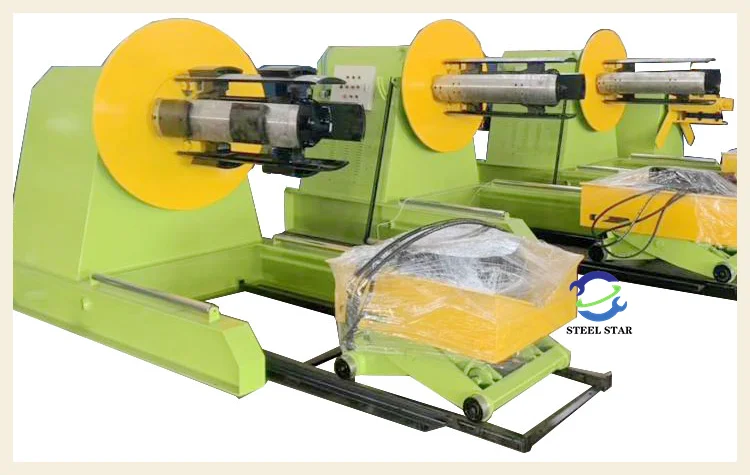
- Cantilever Decoiler: Features a single-sided support arm. The mandrel is extended from one side, allowing for quick and easy loading of coils via overhead crane or forklift without disassembling parts. Ideal for moderate-weight coils and faster changeover applications.
- Double-Support / Shaftless Decoiler: Utilizes two synchronized arms to support the coil from both sides, often using cone-shaped heads that grip the inner diameter. This design offers superior stability for very heavy, wide, or large-diameter coils. “Shaftless” variants eliminate the need for a through-shaft, further simplifying loading.
- By Drive Mechanism:
- Passive Decoilers: Rely on the pulling force of the downstream machine. Tension is created solely by a mechanical brake system. Simple and cost-effective for lighter materials and lower-speed lines.
- Motorized Decoilers: Equipped with an AC or servo motor. They can be programmed to precisely match line speed and maintain consistent tension, essential for high-speed operations, sensitive materials, or processes requiring strict tension control (e.g., in precision stamping or electronics).
Key Components
A typical decoiler system comprises:
- Mandrel/Expanding Shaft: The core that expands to securely hold the coil.
- Frame & Bearings: Provides robust structural support and allows smooth rotation.
- Brake or Motor System: The heart of tension control.
- Arm Support Structure: Cantilever or double-arm design.
- Control Panel: Houses the controls for mandrel expansion, brake adjustment, and motor speed.
- Optional Accessories: Coil cars (for loading), peeler/feeder arms, edge guidance systems (CPC), and vibration dampeners.
Industrial Applications
Decoilers are ubiquitous across industries:
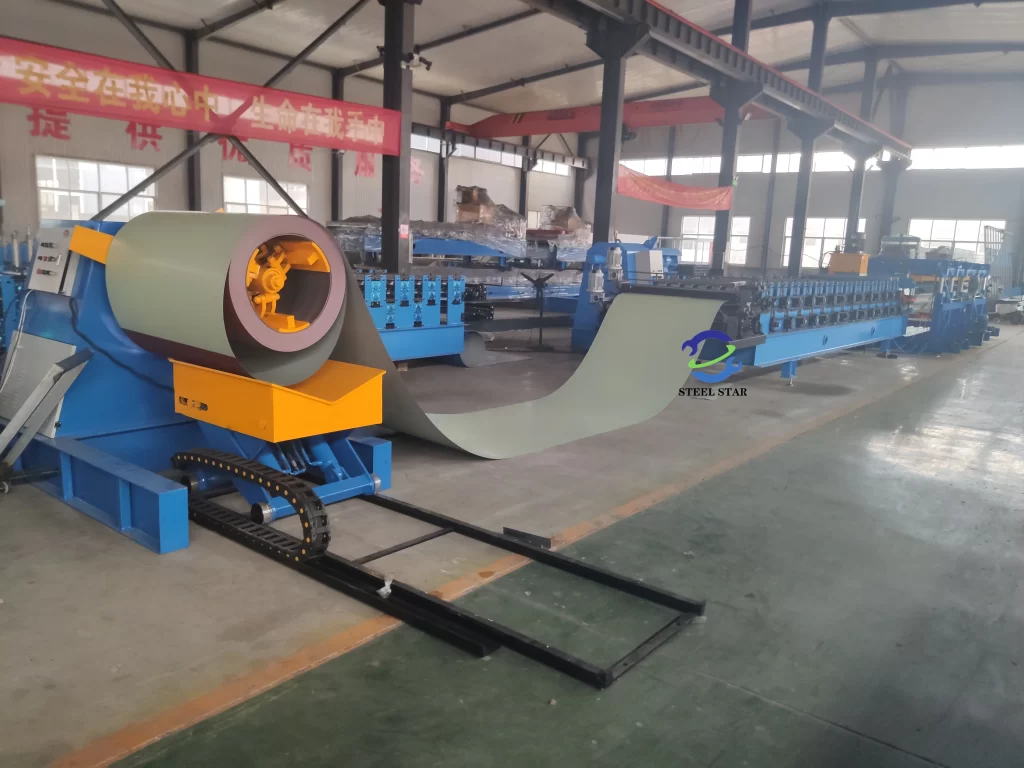
- Metal Stamping & Fabrication: Feeding sheet steel, aluminum, or stainless steel coils into press lines, laser cutters, or roll formers for automotive parts, appliances, and building materials.
- Wire & Cable Production: Unwinding copper rods or wire for drawing, insulating, and cabling processes.
- Converting Industry: Handling paper, film, foil, and laminates for printing, packaging, and labeling machines.
- Textile & Composite Manufacturing: Unrolling fabrics, fibers, or prepreg materials for cutting or layup.
Selection Criteria
Choosing the right decoiler depends on several factors:
- Coil Specifications: Weight, inner/outer diameter, width, and material type (steel, aluminum, delicate film).
- Line Speed & Tension Requirements: High-speed lines demand motorized decoilers.
- Downstream Process: The requirements of the feeder, press, or other processing equipment.
- Floor Space & Automation Needs: Cantilever for easier access, double-support for heavy coils; integration with automated coil loading systems.
- Safety Features: Emergency stops, safety guarding, and lockout mechanisms are crucial.
The decoiler, though often operating behind the scenes, is a cornerstone of automated manufacturing efficiency. By providing the critical first step of controlled material uncoiling, it sets the stage for the entire production process. From robust double-support systems handling multi-ton steel coils to precision motorized decoilers feeding delicate electronic foils, this equipment continues to evolve, integrating with smarter controls and automation to meet the ever-growing demands for speed, precision, and reliability in modern industry. Its role as the “unsung hero” of the production line is both fundamental and indispensable.
Website:
www.greatforming.com (English)
www.arabicgreatforming.com (عربي)
www.russiangreatforming.com(Русский)
www.spanishgreatforming.com(Español)
www.frenchgreatforming.com(Français)
www.portuguesegreatforming.com(Portuguese)