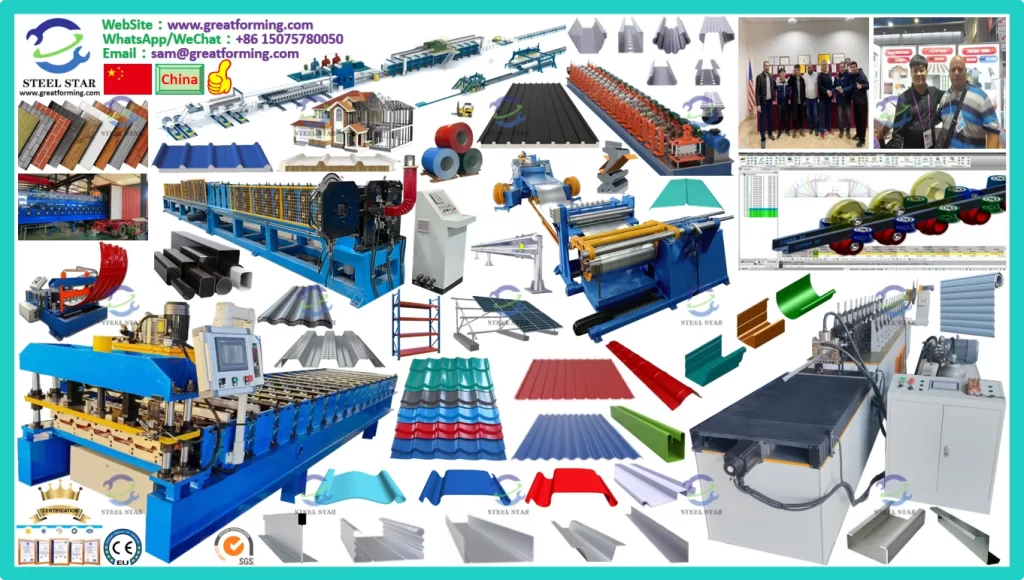


The construction industry, often characterized by its reliance on manual labor and traditional methods, is undergoing a quiet but profound revolution. At the forefront of this transformation in the roofing sector is the metal roof machine—a sophisticated piece of roll-forming equipment that fabricates consistent, high-quality metal roofing and cladding panels on-site, directly from coils of steel or aluminum. More than just a tool, it represents a shift towards automation, precision, efficiency, and sustainability, reshaping how buildings are enclosed around the globe.
This article explores the technology, applications, benefits, and considerations surrounding modern metal roof machines.
1. Core Technology and Operation
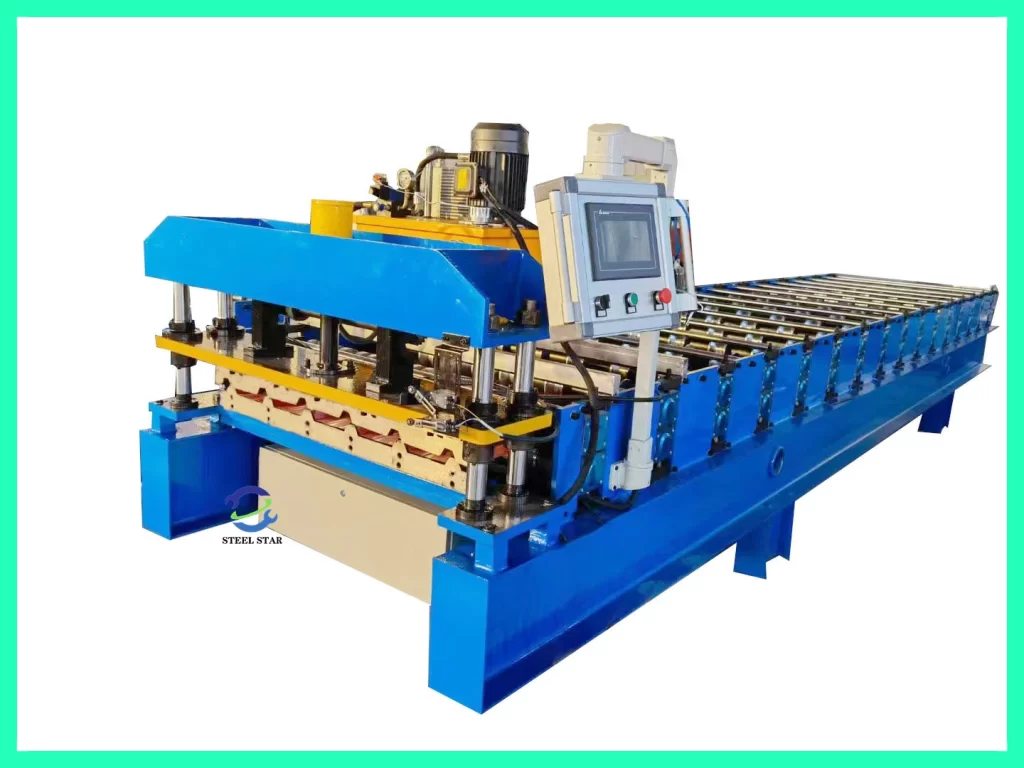
A metal roof machine is essentially a compact, mobile factory. Its fundamental principle is roll-forming, a continuous bending process where a long strip of metal (the coil) passes through a series of roller dies, each station progressively shaping the metal until it emerges as a finished profile.
Key components include:
- Uncoiler/Decoiler: Holds the master coil (typically 1-5 tons) and feeds it into the machine under controlled tension.
- Infeed Guide & Flattener: Ensures the metal enters the forming section evenly and removes any minor curvatures from the coil.
- Roll-Forming Station: The heart of the machine. A series of paired, precision-machined rollers, mounted on a rigid chassis, incrementally form the metal. Each set of rollers performs a specific bend. The number of stations (from 10 to over 20) depends on the profile’s complexity.
- Cutting System: Precisely cuts the formed panel to the desired length. Systems can be simple manual measuring with shear cutters, semi-automatic, or fully computerized (CNC) with flying cutoff saws or shears that cut without stopping the line.
- Control System: The brain of the operation. Modern machines feature Programmable Logic Controllers (PLCs) and Human-Machine Interfaces (HMIs). Operators input panel length, quantity, and profile specifications, and the system automates the speed, cutting, and sometimes even stacking.
- Output Support & Stacker: Supports the newly formed panel as it exits and neatly stacks cut panels, ready for immediate installation.
2. The Diverse World of Profiles
Modern machines are remarkably versatile, often capable of producing multiple profiles through quick roller changes. Common profiles include:
- Standing Seam: The premium choice for low-slope and steep-slope roofs. Panels feature elevated, interlocking seams that are mechanically seamed together on-site, creating a weathertight, expansion-allowing system free of through-fasteners.
- Corrugated & Trapezoidal: Classic, durable profiles for roofing and wall cladding in agricultural, industrial, and commercial applications.
- Tile Effect & Shingle Profiles: Mimic the appearance of traditional clay tiles, wood shakes, or slate but with the durability of metal, popular in residential architecture.
- Custom Profiles: Machines can be engineered to produce unique shapes for architectural projects or specific functional requirements.
3. Compelling Advantages: Why On-Site Fabrication Wins
The adoption of metal roof machines is driven by a powerful combination of economic, logistical, and quality benefits.
Design Flexibility and Customization: Length is no longer a constraint. Panels can be fabricated to run the entire ridge-to-eave distance, eliminating horizontal laps and improving weather resistance. Color and gauge changes are also quick, allowing for gr
Unmatched Efficiency and Speed: Panels are produced at the point of consumption, eliminating lead times from off-site suppliers. Production rates can reach 30-50 meters per minute or more. This just-in-time manufacturing dramatically accelerates project timelines, a critical factor in today’s fast-paced construction environment.
Dramatic Reduction in Material Waste and Cost: Transporting pre-formed panels involves “air shipping”—significant wasted space between the peaks of the profiles. Coils, however, are dense and compact. A single truck can carry enough coil to produce panels for an entire large building, slashing transportation costs by up to 70%. On-site cutting to exact lengths also minimizes trim waste to near zero.
Superior Quality Control: The automated process produces panels of exceptional consistency in shape, dimension, and finish. On-site production avoids the damage (dings, scratches, bending) that can occur during the transportation and handling of pre-formed panels.
Logistical Simplicity: Managing the delivery and staging of long, cumbersome pre-formed panels on a congested site is a major challenge. Machines simplify logistics to handling compact, heavy coils and neatly stacked, site-cut panels.
Design Flexibility and Customization: Length is no longer a constraint. Panels can be fabricated to run the entire ridge-to-eave distance, eliminating horizontal laps and improving weather resistance. Color and gauge changes are also quick, allowing for greater architectural expression.
- Economic Empowerment for Contractors: For roofing contractors, owning a machine transforms their business model. It increases profit margins, provides a competitive advantage through faster completion times, and allows them to offer superior quality and service directly to their clients.
4. Applications Across the Built Environment
The technology is not limited to one sector:
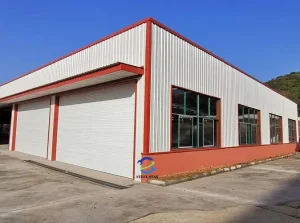
- Commercial & Industrial: Large-scale warehouses, factories, distribution centers, and big-box retail stores are ideal candidates, where speed and economy are paramount.
- Agricultural: Barns, sheds, and storage facilities benefit from the durable, cost-effective shelter.
- Residential: Growing in popularity for custom homes, especially with tile-effect profiles, and for large-scale residential developments.
- Institutional & Architectural: Used for schools, sports complexes, and avant-garde buildings requiring long spans or specific custom profiles.
5. Key Considerations and Challenges
While powerful, the technology is not a universal plug-and-play solution.
- Capital Investment: A high-quality machine represents a significant upfront investment, ranging from tens to hundreds of thousands of dollars depending on capability and automation level. A clear business case and volume of work are necessary for ROI.
- Technical Expertise: Operating and maintaining the machine requires trained personnel. Understanding metallurgy, tooling setup, machine calibration, and basic troubleshooting is essential.
- Project Scale: For very small projects (e.g., a single-family garage), the setup time may not justify on-site production. The economics improve dramatically with scale.
- Site Conditions: Adequate, level space is needed for the machine, coil storage, and panel stacking. Power requirements (often three-phase) must be met.
6. The Future: Smarter, Greener, More Connected
The evolution of the metal roof machine continues:
- Increased Automation: Integration of robotics for automatic stacking, packing, and even loading coils is on the rise.
- IoT and Data Analytics: Machines are becoming nodes in the Internet of Things, transmitting real-time data on production rates, maintenance needs, and material usage to cloud platforms for optimization and predictive maintenance.
- Sustainability Focus: The inherent material efficiency of the process aligns perfectly with green building goals. Machines are also increasingly able to form panels from higher grades of recycled steel and new coated steels that enhance longevity and energy efficiency (e.g., cool-roof coatings).
- Hybrid and Lightweight Designs: Development continues towards more portable, quick-setup machines for contractors and more robust, ultra-high-speed lines for major projects.
The metal roof machine is far more than a niche piece of contractor equipment. It is a catalyst for change, embodying the industrialization of construction. By bringing precision manufacturing to the job site, it solves age-old problems of waste, delay, and logistical complexity. It empowers builders, provides architects with greater freedom, and delivers to building owners a superior, durable product in a fraction of the time. As technology advances, making these machines smarter, more efficient, and more accessible, their role in shaping our built environment—one perfectly formed panel at a time—will only become more central. They are not just making roofs; they are building the future of construction.
Website:
www.greatforming.com (English)
www.arabicgreatforming.com (عربي)
www.russiangreatforming.com(Русский)
www.spanishgreatforming.com(Español)
www.frenchgreatforming.com(Français)
www.portuguesegreatforming.com(Portuguese)