

If you are interested in the product and want more information, please leave your information .

WeChat (China) : +86 15075780050
Email : sam@greatforming.com
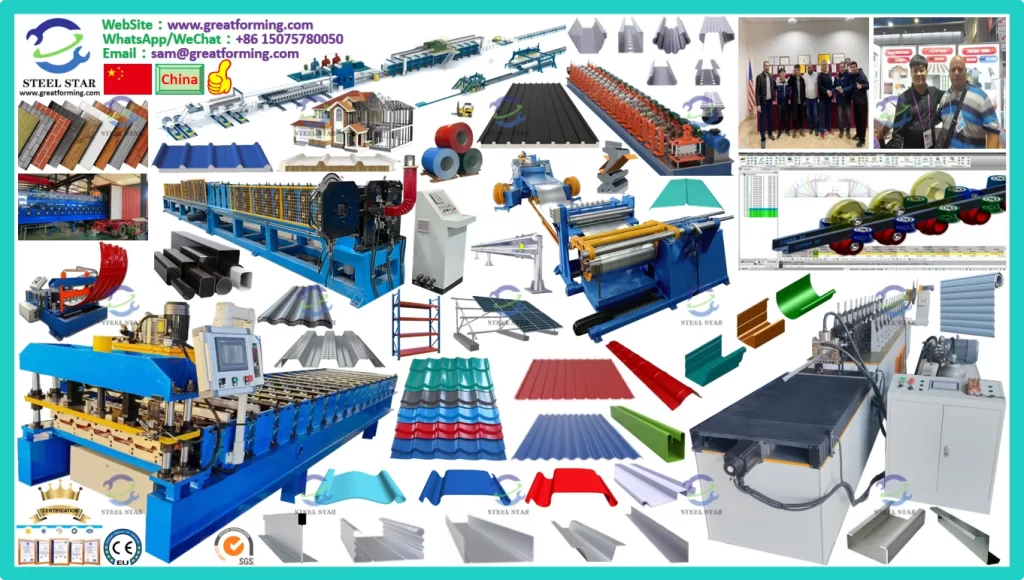
Below is a brochure of our factory products, which can be viewed and downloaded.
Roll forming is a type of rolling that involves continuously bending long strips of metal sheet (typically coiled steel) into the desired cross-section.
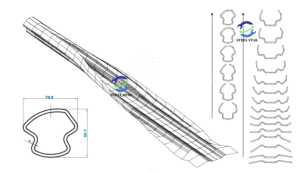
Design the mold shape and number of groups according to the required size. The shrinkage ratio of each group of cold bending is different. Through cold bending group by group, the final desired size can be achieved. Combined with electronic control system, hydraulic system, shearing system and counting encoder to realize automated operation.
Technical Parameters :
- Raw material width : 100mm — 800mm (Can be customized according to your needs)
- Thickness of sheet : 0.5mm — 2mm (Can be customized according to your needs)
- speed : 5 m — 30 m/min (Can be customized according to your needs)
- Voltage : 380v 50hz 3phase / 220v 60hz 3phase (Can be customized according to your needs)
- Language : English / Spanish / Arabic / Russian / Portuguese / German / French (Can be customized according to your needs)
- Material of rollers : Gcr15 / Cr12 / Cr12 Mov (Can be customized according to your needs)
- Motor brand : Siemens / other (Can be customized according to your needs)
- Electronic control PLC : Siemens / Delta / other (Can be customized according to your needs)
- Number of roller rows: According to product design
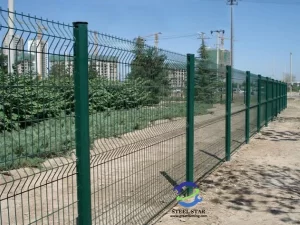
Application Scenarios :
Equipment Production Line:
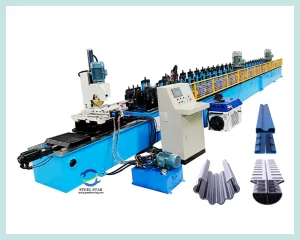
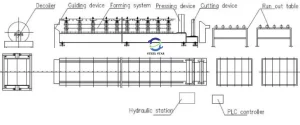
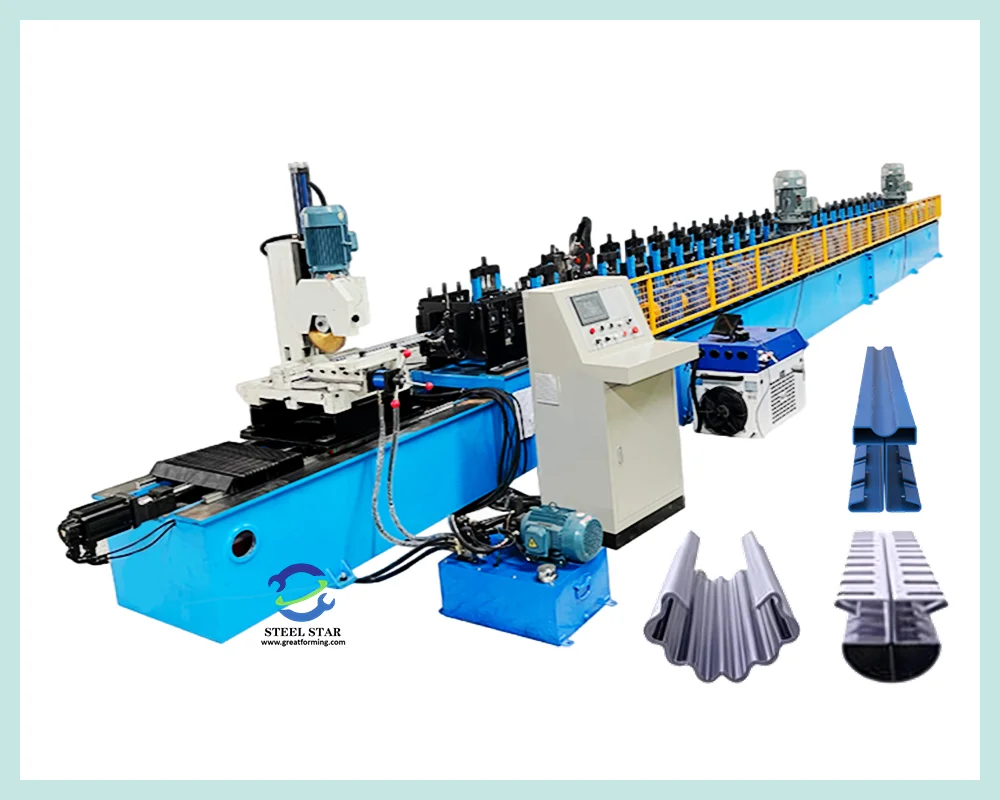
The Metal Fence Post Roll Forming Machine: Engineering the Backbone of Modern Fencing
While the pickets and panels of a fence provide its visual character and barrier function, the true backbone of any durable fencing system lies in its posts. These vertical supports must withstand soil conditions, wind loads, and impact, demanding exceptional strength and consistency. The Metal Fence Post Roll Forming Machine is the specialized industrial equipment designed to manufacture these critical components with precision and efficiency, transforming flat steel coils into the sturdy C, U, Z, and Y-shaped posts that anchor fences worldwide .
What is a Metal Fence Post Roll Forming Machine?
A metal fence post roll forming machine is an automated production line that fabricates structural fence posts from coils of galvanized steel, cold-rolled steel, or other coated metals . Unlike methods that fabricate posts from pre-cut lengths, this continuous process uses a series of progressive roller dies to gradually bend a flat metal strip into a complex, high-strength profile . The result is a product with superior structural integrity, uniform dimensions, and the capacity for high-volume output, essential for agricultural, industrial, and infrastructure projects .
Core Components and the Production Process
The journey from raw steel coil to a finished fence post is a seamless, highly automated operation involving several key stages .
1. Uncoiler (Decoiler): The process begins with a heavy-duty uncoiler that holds and feeds the steel coil. This component often includes features like a press arm to secure the coil during loading and an outward retainer to prevent the steel from sliding during unwinding, ensuring operator safety and material stability .
2. Guiding and Leveling: Before forming, the strip passes through a guiding and leveling device. This ensures the material is perfectly flat and precisely aligned with the roll forming stations, which is critical for preventing twists or bends in the final post .
3. Hydraulic Punching: An integrated hydraulic punching system creates precise holes, slots, or indentations in the flat strip before it is formed . These features are essential for attaching fencing wire, rails, or barbed wire, and the CNC-controlled system ensures consistent spacing and pattern accuracy .
4. Roll Forming Station: This is the core of the machine. The strip passes through a series of forming stands (often 20 to 30 stations), each containing a pair of contoured rollers . Made from high-grade materials like GCr15 bearing steel and chrome-plated for hardness, these rollers progressively shape the metal . Each stand makes an incremental bend until the final profile—be it a C, U, T, or Y shape—is achieved .
5. Cutting System: Once formed, the continuous profile is cut to predetermined lengths. Modern machines typically use a **flying saw** or **flying cut** system . In this method, the cutter moves forward along the production line at the same speed as the material, allowing for cutting without stopping the continuous forming process. This “non-stop” cutting is key to achieving high production speeds .
6. PLC Control System: A central Programmable Logic Controller (PLC) with a touchscreen interface orchestrates the entire line. Operators can set post lengths, punching patterns, and production quantities. The system automatically synchronizes all components, ensuring high precision (often within ±1mm) and minimizing material waste .
Types of Fence Posts Produced
The versatility of the roll forming process allows manufacturers to produce a wide array of post profiles tailored to specific applications .
C and U-Channel Posts: These are among the most common profiles, offering an excellent strength-to-weight ratio. They are widely used in chain-link fencing, welded wire mesh fences, and as structural supports in various industrial settings .
Y-Posts (Star Pickets): A classic profile in agricultural fencing, the Y-post features a central spine with three radiating arms. This design provides exceptional rigidity and is ideal for supporting barbed wire or plain wire in livestock management .
T-Posts: Known for their simple yet effective design, T-posts are popular for temporary and permanent fencing on farms and construction sites due to their ease of installation .
Square and Rectangular Posts: Used in applications requiring a more finished look or greater torsional strength, such as in residential privacy fencing, gate supports, and highway signposts .
Advantages of Automated Roll Forming
The use of automated roll forming machines offers significant advantages over older methods like manual fabrication or traditional hot rolling .
1. Superior Structural Integrity: The cold rolling process work-hardens the steel, increasing its tensile strength. Modern machines can produce complex profiles with reinforced ribs and tapered ends that are stronger and lighter than earlier designs .
2. High Production Speed and Efficiency: With production speeds ranging from 10 to 30 meters per minute, these machines can produce hundreds of posts in a single shift, fulfilling large orders rapidly .
3. Consistency and Precision: PLC control ensures every post is identical, with precise dimensions and accurate hole placement. This uniformity is vital for creating fence lines that are straight, plumb, and easy to assemble .
4. Material and Cost-Effectiveness: The continuous process minimizes material waste. By integrating punching and cutting into the line, secondary handling is eliminated, significantly reducing labor costs .
5. Design Flexibility: With adjustable roller dies and programmable controls, a single machine can produce a variety of profiles. Manufacturers can easily switch between post types to meet specific project requirements or customize features like hole patterns and lengths .
Applications Across Industries
The metal posts produced by these machines are fundamental to a vast range of fencing applications .
Agriculture: For enclosing pastures, securing livestock, and protecting crops with durable and long-lasting fences .
Infrastructure: Manufacturing highway signposts, guardrail posts, and noise barrier supports that must meet stringent safety and durability standards .
Commercial and Industrial Security: Creating robust perimeters for warehouses, factories, schools, and secure facilities using chain-link, palisade, or welded mesh fences mounted on strong metal posts .
Residential: Providing the reliable structural framework for ornamental metal fences, privacy screens, and property boundary markers .
Specialty Applications: Including vineyards and orchards, where specific post designs are needed to support trellising systems .
The metal fence post roll forming machine is a critical piece of equipment that operates behind the scenes to create the fundamental supports for our built environment. By transforming raw steel into precise, high-strength profiles, this technology enables the rapid, cost-effective, and reliable construction of fences that secure agriculture, define property, and protect infrastructure. As a testament to modern engineering, it ensures that the backbone of any great fence is as strong and durable as the fence itself .
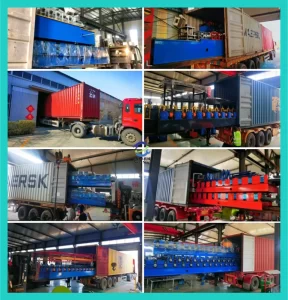
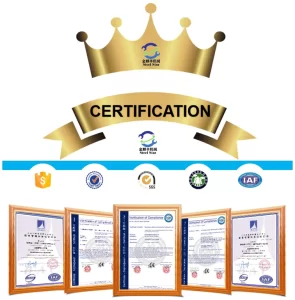
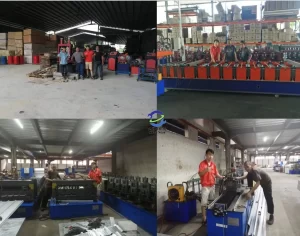
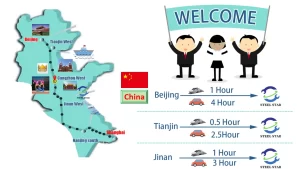
Factory Information:

Website:
www.greatforming.com (English)
www.arabicgreatforming.com (عربي)
www.russiangreatforming.com(Русский)
www.spanishgreatforming.com(Español)
www.frenchgreatforming.com(Français)
www.portuguesegreatforming.com(Portuguese)