

If you are interested in the product and want more information, please leave your information .

WeChat (China) : +86 15075780050
Email : sam@greatforming.com
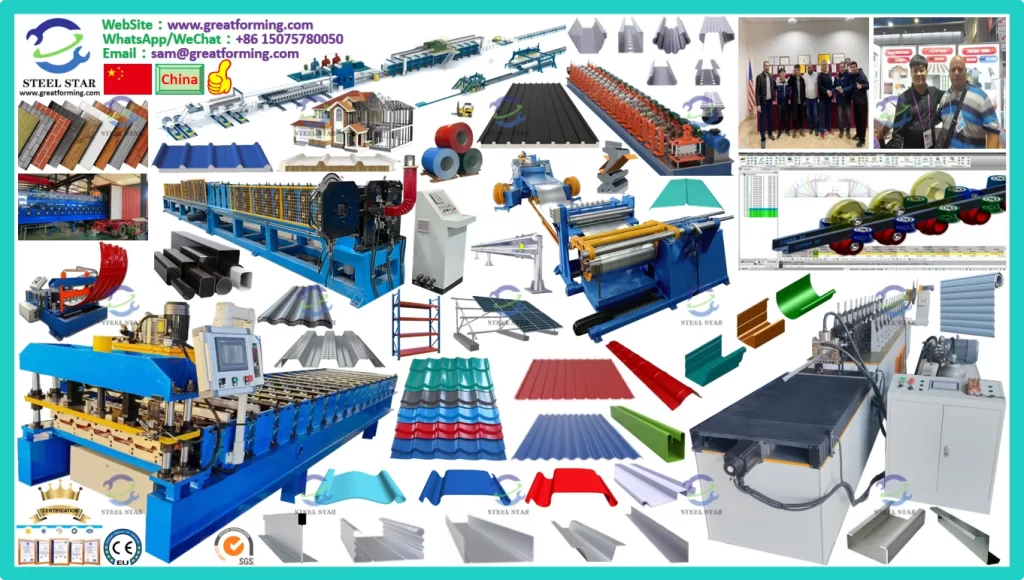
Below is a brochure of our factory products, which can be viewed and downloaded.
Roll forming is a type of rolling that involves continuously bending long strips of metal sheet (typically coiled steel) into the desired cross-section.
Design the mold shape and number of groups according to the required size. The shrinkage ratio of each group of cold bending is different. Through cold bending group by group, the final desired size can be achieved. Combined with electronic control system, hydraulic system, shearing system and counting encoder to realize automated operation.
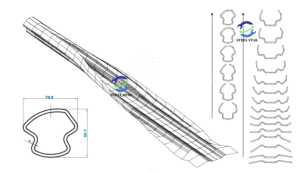
Technical Parameters :
- Raw material width : 200mm — 1250mm (Can be customized according to your needs)
- Thickness of sheet : 0.3mm — 1.0mm (Can be customized according to your needs)
- speed : 5 m — 30 m/min (Can be customized according to your needs)
- Voltage : 380v 50hz 3phase / 220v 60hz 3phase (Can be customized according to your needs)
- Language : English / Spanish / Arabic / Russian / Portuguese / German / French (Can be customized according to your needs)
- Material of rollers : Gcr15 / Cr12 / Cr12 Mov (Can be customized according to your needs)
- Motor brand : Siemens / other (Can be customized according to your needs)
- Number of roller rows: According to product design
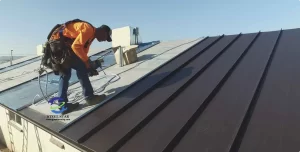
Application Scenarios :
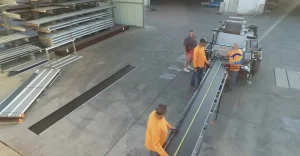
Equipment Production Line:
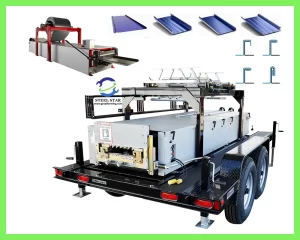
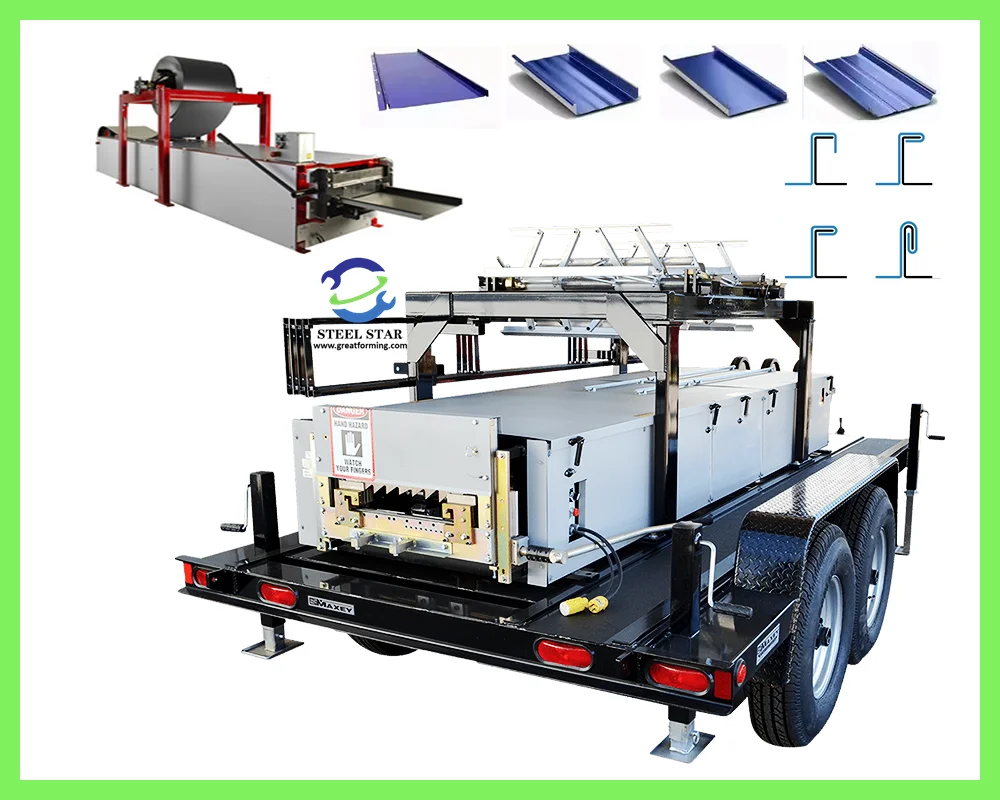
The Ultimate Guide to Portable Standing Seam Machines
In the world of metal roofing, precision and efficiency are paramount. Few tools embody these principles better than the **portable standing seam machine**. This specialized equipment has transformed the metal roofing industry by allowing contractors to fabricate high-quality standing seam panels directly on-site—eliminating the logistical challenges of transporting pre-made panels and enabling custom-length production for every unique roof profile.
This comprehensive guide explores the mechanics, types, benefits, specifications, and purchasing considerations for portable standing seam machines.
What is a Portable Standing Seam Machine?
A portable standing seam machine is a rollforming device designed to shape flat metal coil into interlocking standing seam roofing panels directly at the job site . Unlike stationary factory equipment, these machines are built for mobility—they can be transported on trailers, moved across rooftops, and operated where they’re needed most.
The process is elegantly simple: flat metal coil is fed into the machine, passes through a series of precision rollers that gradually shape the metal into the desired profile, and is then cut to the exact length required for the installation . The result is seamless, custom-fit panels that deliver superior weather resistance and aesthetic appeal.
The Standing Seam Advantage
Standing seam metal roofing systems are distinguished by their raised seams—typically 1 to 2 inches tall—that interlock to create a continuous, weathertight barrier . Unlike traditional corrugated roofing that relies on exposed fasteners, standing seam systems use concealed clips that allow the panels to expand and contract with temperature changes without compromising the roof’s integrity .
Key benefits include:
Superior waterproofing: Interlocking seams eliminate the need for exposed fasteners, dramatically reducing leak points
Exceptional durability: Metal roofs can last 40-50 years with proper maintenance
Thermal expansion accommodation: Concealed clip systems allow panels to move naturally with temperature fluctuations
Aesthetic versatility: Clean, modern lines suitable for both residential and commercial architecture
Energy efficiency: Can be installed over existing roofs with insulation layers
Types of Portable Standing Seam Machines
Portable standing seam machines come in various configurations to suit different project requirements, power sources, and budget levels .
By Power Source
Electric (Corded) Machines
These plug-and-play units deliver consistent, uninterrupted power ideal for large-scale projects. They offer reliable performance without the need for air compressors, though they require access to electrical outlets or generators .
Battery-Operated Machines
Cordless tools powered by lithium-ion batteries offer unmatched portability for rooftop work and remote sites. Modern models provide extended run times, though spare batteries may be needed for all-day use .
Pneumatic Machines
Air compressor-powered seamers deliver fast, consistent locking with minimal operator fatigue. They’re lightweight and ideal for mid-sized projects, though they require compatible compressors and hose setups .
Hydraulic Machines
Heavy-duty units designed for industrial-scale applications. Hydraulic seamers deliver high torque for thick gauge metals and long runs, making them suitable for demanding environments .
By Seam Type
Single Lock Machines
These perform one crimping operation to join panel edges. They’re best suited for aluminum and thinner steel gauges in residential applications where moderate weather resistance is sufficient .
Double Lock Machines
Performing two crimping operations, these create tighter, more secure seams with superior weatherproofing. They’re ideal for coastal areas, high-wind zones, and industrial applications where building codes demand enhanced performance .
Snap Lock Machines
Designed for quick installation, snap lock panels interlock without mechanical seaming. The SSQ275 NewLock profile exemplifies this category—it can be installed as a snap-lock and later mechanically seamed if higher wind resistance is required .
By Automation Level
Manual Machines
Entry-level units requiring physical effort to feed and form metal. While cost-effective and highly portable, they demand skilled operators and are slower than automated alternatives .
Semi-Automatic Machines
Motorized units with basic controls that automate feeding and forming while requiring manual oversight for cutting and adjustments .
Fully Automatic Machines
Advanced units featuring PLC control systems, digital interfaces, and automated cutting. These can produce panels at speeds up to 20 meters per minute with minimal operator intervention .
Key Specifications and Performance Parameters
Understanding technical specifications is essential for selecting the right machine for your operation.
Material Compatibility
| Material | Typical Gauge Range | Notes |
|———-|——————-|——-|
| Steel | 24-26 ga (0.5-0.8 mm) | Most common; 24 ga for commercial, 26 ga for residential |
| Aluminum | .024″-.040″ | Lightweight, corrosion-resistant |
| Copper | 16-20 oz | Premium architectural applications |
| Zinc | 0.7-1.0 mm | High-end, self-healing properties |
Production Speed
Speed varies significantly by machine class:
Entry-level: 2-6 m/min (manual or basic electric)
Professional: 12-15 m/min (semi-automatic)
Industrial: 15-20+ m/min (fully automatic)
Machine Weight and Dimensions
Light-duty: 300-600 kg, suitable for single-operator transport
Mid-range: 1,000-2,000 kg, typically trailer-mounted
Heavy-duty: 2,500-6,000 kg, requiring heavy-duty trailers
Power Requirements
Most professional machines operate on:
110V/220V single-phase: For smaller units and residential applications
220V/440V three-phase: For industrial machines requiring consistent torque
Gas/hydraulic: For remote job sites without electrical access
How a Portable Standing Seam Machine Works
The operational workflow is straightforward but requires attention to detail:
Step 1 – Material Loading
Metal coil is loaded onto a decoiler or reel stand. Coils typically weigh 500-1,000 lbs and must be properly aligned to ensure consistent feeding .
Step 2 – Feeding and Setup
The coil is fed into the machine’s entry guides. Modern machines feature programmable length controllers that allow operators to preset panel lengths before production begins .
Step 3 – Progressive Rollforming
As the metal passes through successive roller stations, each set gradually shapes the profile. The precision-machined rollers—typically hardened steel with chrome coating—ensure consistent geometry without stressing the material .
Step 4 – Cutting
At the desired length, an integrated shear (manual or hydraulic) cuts the panel cleanly. Hydraulic shears are standard on professional machines, providing clean edges without burrs .
Step 5 – Installation
Finished panels are immediately ready for installation. On-site production allows for real-time adjustments if field measurements vary from plans .
Daily/After Each Use
– Clean rollers to prevent debris buildup that can scratch panels
– Inspect shear blades for wear
– Check for loose fasteners or misaligned guides
Weekly
– Lubricate moving parts with manufacturer-recommended oils
– Inspect hydraulic fluid levels (hydraulic machines)
– Verify electrical connections and safety interlocks
Monthly
– Perform systematic inspection of all roller stations
– Check drive chains and belts for tension and wear
– Calibrate length measuring systems
Seasonal/Annual
– Comprehensive inspection by qualified technician
– Hydraulic system service (fluid change, filter replacement)
– Trailer maintenance (bearings, tires, brakes)
Critical: Always follow manufacturer maintenance schedules. Using incorrect lubricants or replacement parts can void warranties and create safety hazards .
Choosing the Right Machine: Key Considerations
1. Project Scope and Volume
Small residential: Lightweight machine with 5″ panel capability; manual or basic electric
Mixed residential/commercial: Versatile mid-range machine (SSH or SSQ series) with multiple profile capabilities
Large commercial/industrial: Heavy-duty machine with 6″+ panel capability, high-speed production, notching functions
2. Material Types
Will you primarily run 26ga steel for residential, or 24ga steel and aluminum for commercial? Ensure machine capacity matches your typical material use .
3. Profiles Required
Consider both current and future needs. The SSQ3’s 16-profile capability offers growth potential, while specialized machines may limit future opportunities .
4. Mobility Needs
How often will the machine move between job sites? Trailer-mounted configurations offer convenience but add cost. Lighter machines may suffice for shop-based operations with occasional transport .
The portable standing seam machine represents a significant investment in capability, efficiency, and quality for metal roofing contractors. By enabling on-site fabrication of custom-length panels, these machines eliminate transportation constraints, reduce waste, and provide installation flexibility that factory-produced panels cannot match.
Whether starting with an entry-level SSR machine or investing in a flagship SSQ3 with notching capabilities, the core value proposition remains consistent: complete control over panel quality, length, and installation timing . For professionals looking to elevate their metal roofing business, the portable standing seam machine is not merely equipment—it’s a mobile manufacturing plant that pays for itself through efficiency, customer satisfaction, and the ability to tackle projects of any size or complexity.
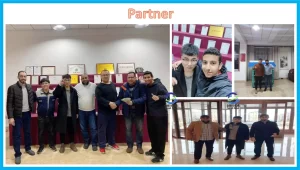
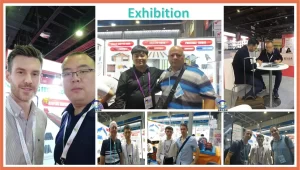
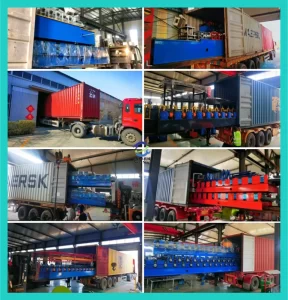
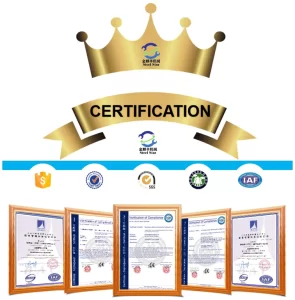
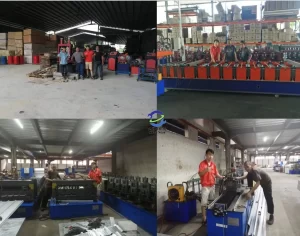
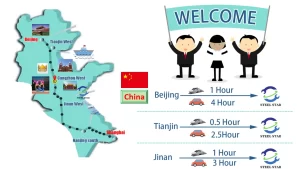
Factory Information:
Website:
www.greatforming.com (English)
www.arabicgreatforming.com (عربي)
www.russiangreatforming.com(Русский)
www.spanishgreatforming.com(Español)
www.frenchgreatforming.com(Français)
www.portuguesegreatforming.com(Portuguese)