

The Sandwich Panel Machine: Engineering the Future of Insulated Building Envelopes
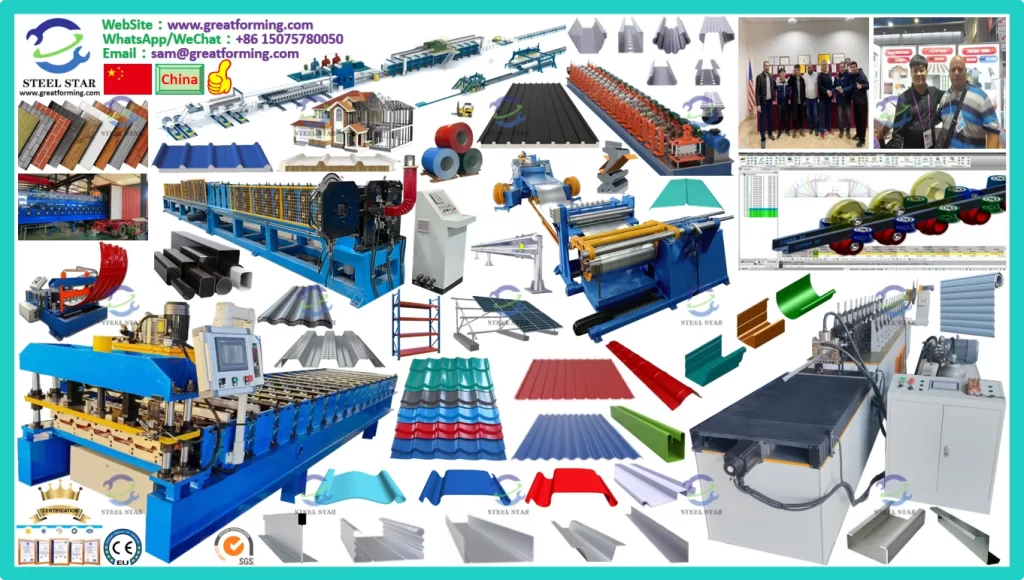
In an era demanding energy efficiency, rapid construction, and versatile building materials, the sandwich panel has emerged as a quintessential modern solution. At the heart of its mass production lies a marvel of industrial engineering: the Sandwich Panel Machine. This continuous, automated production line is responsible for manufacturing the composite panels that form the insulated skins of warehouses, cold storage facilities, clean rooms, and modern architectural facades.
What is a Sandwich Panel?
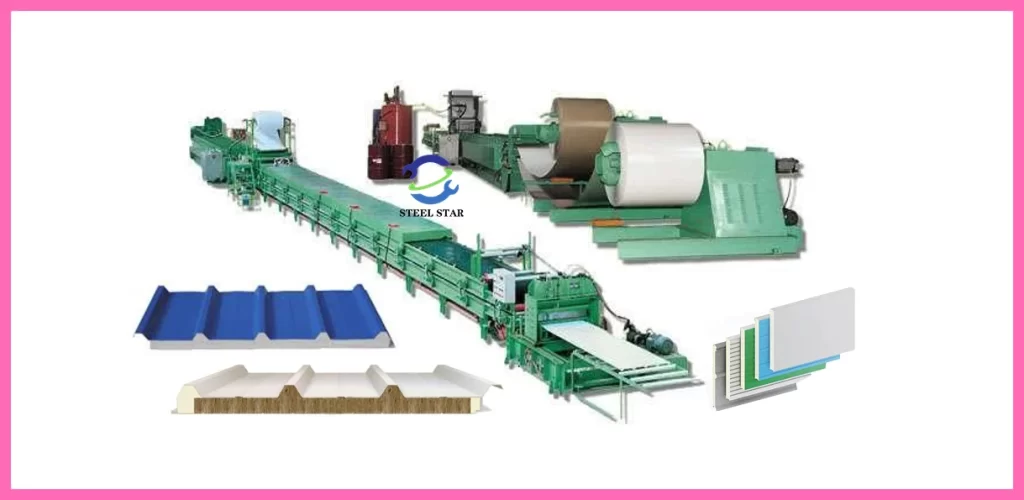
Understanding the machine requires first understanding its product. A sandwich panel is a lightweight, high-strength composite material consisting of three layers: two durable outer metal “skins” (typically color-coated galvanized steel or aluminum) and a rigid insulating core bonded between them. Common core materials include:
- Expanded Polystyrene (EPS): For cost-effective thermal insulation.
- Polyurethane (PUR) / Polyisocyanurate (PIR): For superior thermal performance and fire resistance.
- Mineral Wool (Rock Wool): For exceptional fire safety and acoustic insulation.
The result is a panel offering outstanding thermal efficiency (low U-values), structural rigidity, and a finished appearance in a single element.
The Core Function of the Machine
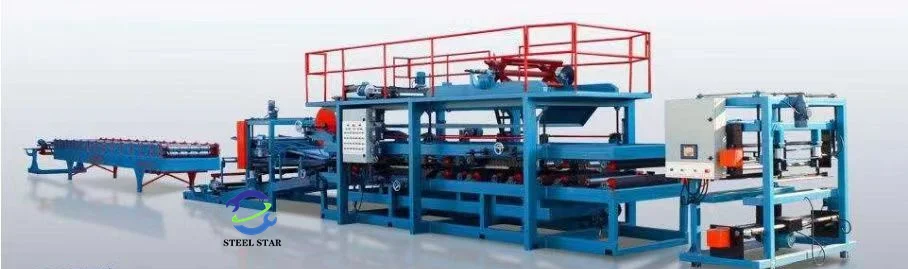
A Sandwich Panel Machine is a fully integrated, continuous foaming and laminating line. Its primary function is to precisely feed the metal coils, inject and cure the liquid insulating core, and permanently bond all three layers under controlled heat and pressure, finally cutting the continuous panel into specified lengths.
Anatomy of a Production Line
A complete line is a symphony of synchronized stations:
- Uncoiling and Pre-treatment:
- Decoilers: Heavy-duty units hold and feed the top and bottom metal coils.
- Leveling & Feeding: Precision rollers flatten the metal and ensure a consistent, aligned feed.
- Embossing/Printing (Optional): Some lines include a station to add a decorative wood-grain or textured pattern onto the metal surface.
- Forming Stations:
- Roll Formers: These critical sections feature sets of precision rollers that cold-form the flat metal strips into specific profiles for both the inner and outer skins. Profiles include micro-rib, trapezoidal, or custom architectural designs, which enhance the panel’s stiffness.
- The Laminating & Foaming Tunnel – The Heart of the Process:
- Panel Alignment & Pre-heating: The formed top and bottom sheets are guided into the tunnel, often passing through heaters to optimize adhesive bonding.
- Core Mixing & Injection: For PUR/PIR panels, this is the most critical stage. Precision metering units mix the liquid polyol and isocyanate components (and other additives) and inject the mixture as a rising foam between the two advancing metal skins. For EPS or mineral wool, the pre-cut rigid core is automatically fed and positioned.
- Double Belt Press (Laminator): The nascent panel enters a long, heated double-belt press. The synchronized upper and lower belts apply perfectly even pressure across the panel’s width, controlling the foam’s expansion, ensuring consistent core density, and creating a monolithic bond as the core cures. The belt’s temperature is precisely controlled.
- Curing, Cooling & Cutting:
- Curing Zone: The panel continues through a controlled-temperature tunnel to allow the core (especially foam) to fully cure and achieve its final physical properties.
- Cooling Zone: Stabilizes the panel temperature before cutting.
- Cut-to-Length System: A high-precision computer-controlled saw (usually a flying cut-off saw) cuts the continuous panel into ordered lengths without stopping the production line.
- Stacking & Packaging:
- Automatic Stacker: A robotic or mechanical stacker gently collects the finished panels, organizes them by order, and prepares them for wrapping and shipment.
Key Technological Features and Advantages
- Complete Automation & PLC Control: The entire process—from speed and temperature to chemical ratio and cut length—is governed by a central Programmable Logic Controller (PLC). This ensures repeatable quality and allows for quick changeovers between panel thicknesses and profiles.
- Precision Metering and Mixing (for foam cores): Advanced high-pressure pouring systems ensure a perfectly homogeneous mix and even distribution of foam, which is critical for uniform insulation value and panel flatness.
- Energy Efficiency in Production: The machine’s own heat recovery systems often recycle thermal energy from the curing process, reducing operational costs.
- High Output and Consistency: A single line can produce vast quantities of panels with identical dimensions, core properties, and aesthetic quality, which is essential for large-scale construction projects.
- Design Flexibility: By changing the roll-forming heads and adjusting parameters, manufacturers can produce panels of varying thicknesses (e.g., 30mm to 200mm), widths, profiles, and with different metal finishes.
Impact on the Construction Industry
The advent of the Sandwich Panel Machine has revolutionized building envelope construction:
- Speed of Construction: Pre-fabricated, large-format panels enable rapid “dry” installation, drastically reducing on-site labor and project timelines.
- Superior Building Performance: It facilitates the mass production of panels with exceptionally high thermal efficiency, directly contributing to reduced energy consumption for heating and cooling in buildings.
- Hygienic & Specialized Environments: The seamless, easy-to-clean surfaces make these panels ideal for food processing plants, pharmaceutical facilities, and hospitals.
The Sandwich Panel Machine is a transformative piece of industrial equipment. It transcends simple manufacturing to become an enabler of high-performance, sustainable architecture. By seamlessly integrating materials science, precision mechanical engineering, and process automation, it efficiently produces intelligent building components that combine structure, insulation, and finish in one. As global standards for energy conservation and construction efficiency continue to rise, the technology behind these machines will remain pivotal in shaping the built environment, proving that the most advanced walls and roofs are truly made of more than the sum of their parts.
Website:
www.greatforming.com (English)
www.arabicgreatforming.com (عربي)
www.russiangreatforming.com(Русский)
www.spanishgreatforming.com(Español)
www.frenchgreatforming.com(Français)
www.portuguesegreatforming.com(Portuguese)