

Bending the Rules: The Essential Guide to the Vertical Roof Curving Machine
In the evolution of architectural metalwork, the ability to merge form and function has always defined great design. From the sweeping canopies of modern airports to the elegant domes of sports stadiums, curved roofs represent a pinnacle of structural aesthetics. Behind these striking architectural features lies a specialized piece of equipment: the Vertical Roof Curving Machine. This innovative technology allows fabricators and contractors to transform standard straight roofing panels into precisely curved components, unlocking new dimensions of design flexibility .
What is a Vertical Roof Curving Machine?
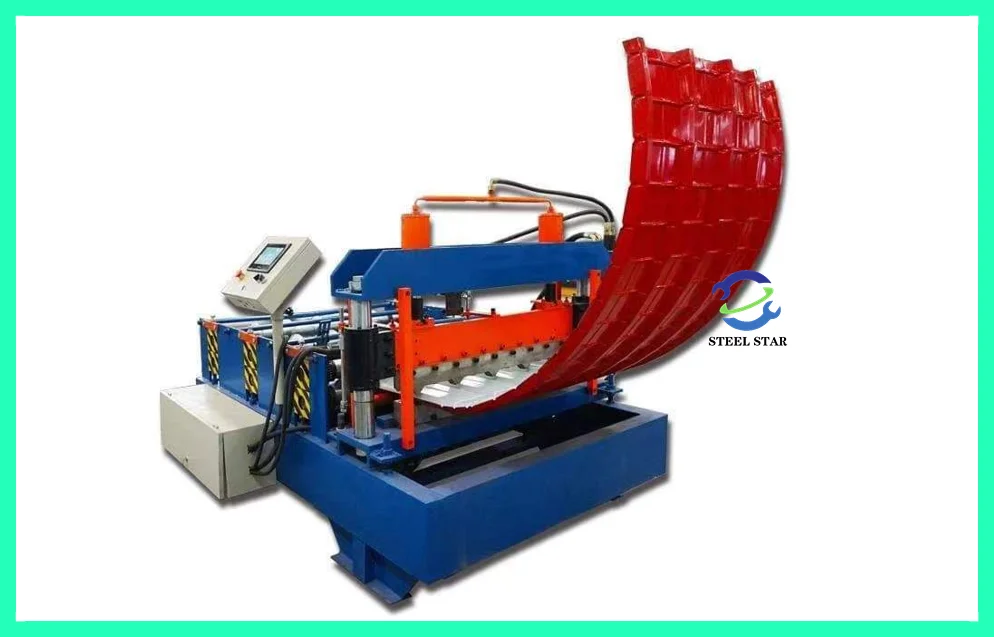
A vertical roof curving machine, also known as a vertical arching machine or crimp curving machine, is a specialized piece of equipment designed to bend pre-formed metal roofing panels into smooth, accurate curves . Unlike roll forming machines that create the panel profile from flat coil stock, curving machines work with already-profiled panels—such as standing seam, corrugated, or trapezoidal sheets—and shape them into arches or curves while preserving the integrity of the original profile .
The term “vertical” refers to the orientation of the panel during the bending process, which allows for efficient handling of long panels and precise control over the curvature radius .
The Technology Behind the Curve
How Vertical Curving Works
The vertical roof curving machine operates on a principle of incremental pressing or roll bending. The panel is fed vertically through the machine, where a series of rollers or pressing dies gradually shape the material into the desired arc . This step-by-step approach distributes bending forces evenly along the length of the panel, allowing the metal to form naturally without excessive stress concentration .
Key aspects of the technology include:
- Step-by-Step Forming: The machine applies pressure incrementally, creating a smooth, continuous curve without kinking or flattening the profile .
- PLC Control Systems: Modern machines feature programmable logic controllers (PLC) with touch-screen interfaces, allowing operators to precisely set curvature parameters, radius, and pressing sequences for repeatable, accurate results .
- Dual-Function Capability: Many vertical curving machines also support horizontal operation, offering maximum versatility for different project requirements .
Types of Curving Machines
The market offers several configurations to meet diverse production needs:
- Hydraulic Curving Machines: Utilize hydraulic power to deliver stable, continuous pressure for consistent and precise forming. Ideal for heavy-duty applications and thicker materials .
- Electric Crimping Machines: Employ electric motors and gear systems for efficient operation, often with servo control for high-speed precision .
- Double Pressing Curve Forming Machines: Advanced systems that can process both sides of a panel simultaneously or in sequence for complex curved profiles .
Advantages of Vertical Roof Curving Machines
The adoption of vertical curving technology offers numerous benefits for manufacturers and contractors:
- Preservation of Profile Integrity: The pressing curve forming process minimizes risks such as profile flattening, material deformation, surface scratches, or coating cracks. This is especially critical for high-end architectural roofing systems where both appearance and precision are paramount .
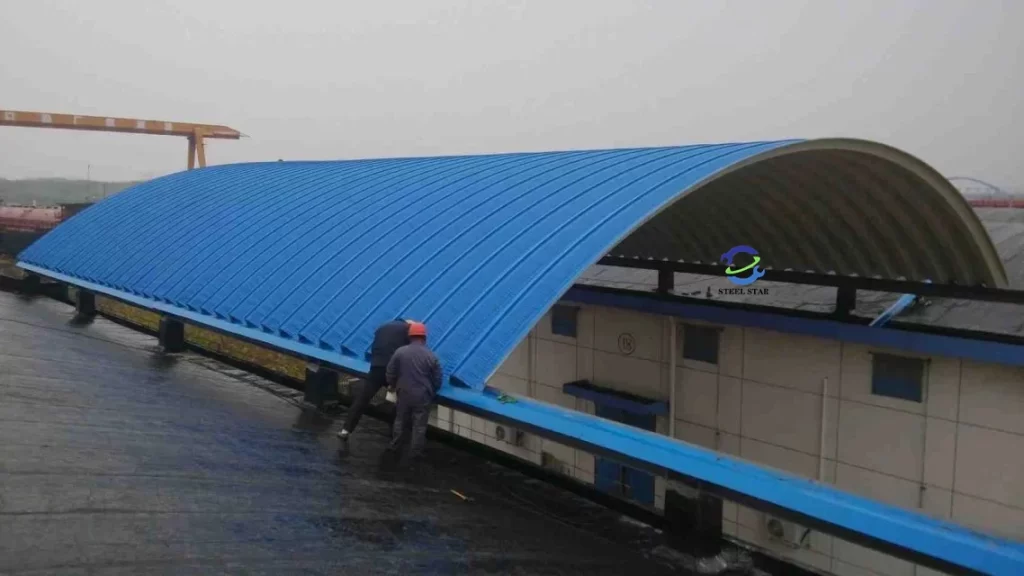
- Design Flexibility: Architects and builders gain the freedom to incorporate curved elements into their designs, from subtle arches to dramatic domes, without compromising structural performance .
- On-Site Capability: Many vertical curving machines are designed to be mobile, allowing contractors to bring the curving process directly to the job site. This eliminates transportation challenges associated with pre-curved panels and allows for last-minute adjustments .
- Material Versatility: These machines can handle a wide range of materials, including galvanized steel, color-coated steel, aluminum, and copper, typically in thicknesses ranging from 0.3mm to 1.0mm .
- Cost Efficiency: By curving panels on-demand, manufacturers reduce waste associated with pre-ordering custom curved sections and minimize the labor required for on-site modifications .
Applications Across Industries
Vertical roof curving machines serve a diverse range of construction sectors:
Industrial and Commercial Construction
- Large-Span Warehouses and Factories: Curved roofing provides excellent load distribution and wind resistance for industrial structures .
- Aircraft Hangars: The clear-span capabilities of arched roofs make them ideal for hangar construction .
- Logistics Centers: Curved roofs offer efficient water runoff and durable protection for large distribution facilities .
Architectural and Public Buildings
- Stadiums and Sports Facilities: Iconic curved roofs define modern athletic venues .
- Airports and Transportation Hubs: Sweeping rooflines create welcoming, memorable spaces for travelers .
- Shopping Centers and Exhibition Halls: Curved elements add visual interest and architectural distinction .
- Canopies and Walkways: Covered walkways with graceful arches enhance pedestrian experiences .
Specialized Structures
- Domes and Barrel-Vault Roofs: Precision-curved panels enable the construction of geometrically complex roof forms .
- Agricultural Shelters: Curved roofs provide efficient coverage for barns and livestock facilities .
- Religious and Cultural Buildings: Mosques, churches, and cultural centers often incorporate domes and arches as signature design elements .
Integration with Production Lines
One of the key advantages of modern vertical curving machines is their ability to integrate seamlessly with existing roll forming operations. When placed downstream of a roofing roll forming line, these machines enable a continuous production workflow—from flat coil to straight panel to fully curved profile—in a single, efficient process .
This integration eliminates multiple setups and material transfers, reducing labor costs and improving overall project efficiency . For high-output operations, adding a vertical curving machine significantly expands production capabilities and market reach .
Technical Considerations
When selecting a vertical roof curving machine, several technical factors deserve attention:
- Material Compatibility: Ensure the machine can handle your specific panel profiles and material thicknesses .
- Curving Precision: Look for machines capable of ±1mm accuracy to ensure consistent quality .
- Control System: PLC-based controls with intuitive interfaces simplify operation and reduce training requirements .
- Tooling Customization: The ability to customize roller sets and pressing dies for specific profiles adds long-term value .
- After-Sales Support: Reliable technical support and spare parts availability are essential for minimizing downtime .
The Future of Curved Metal Roofing
As architectural trends continue to embrace organic forms and sustainable materials, the demand for curved metal roofing is expected to grow. Vertical roof curving machines will play an increasingly vital role in meeting this demand, enabling fabricators to deliver complex geometries with factory precision and on-site efficiency.
Advancements in control technology, including integration with Building Information Modeling (BIM) systems, promise to further streamline the design-to-production workflow, making curved metal roofing accessible for projects of all scales.
The vertical roof curving machine represents a perfect union of engineering precision and architectural ambition. By transforming straight panels into graceful curves, this technology empowers builders to create structures that are not only functional but truly inspiring. Whether for a massive industrial complex or an intimate cultural landmark, the ability to bend metal roofing to exact specifications ensures that the buildings of tomorrow can rise to meet both practical needs and aesthetic dreams .
Website:
www.greatforming.com (English)
www.arabicgreatforming.com (عربي)
www.russiangreatforming.com(Русский)
www.spanishgreatforming.com(Español)
www.frenchgreatforming.com(Français)
www.portuguesegreatforming.com(Portuguese)